Introduction
Have you ever wondered how to find the height of a building without climbing it or using a measuring tape? This is where trigonometry height questions become useful in Secondary Maths.
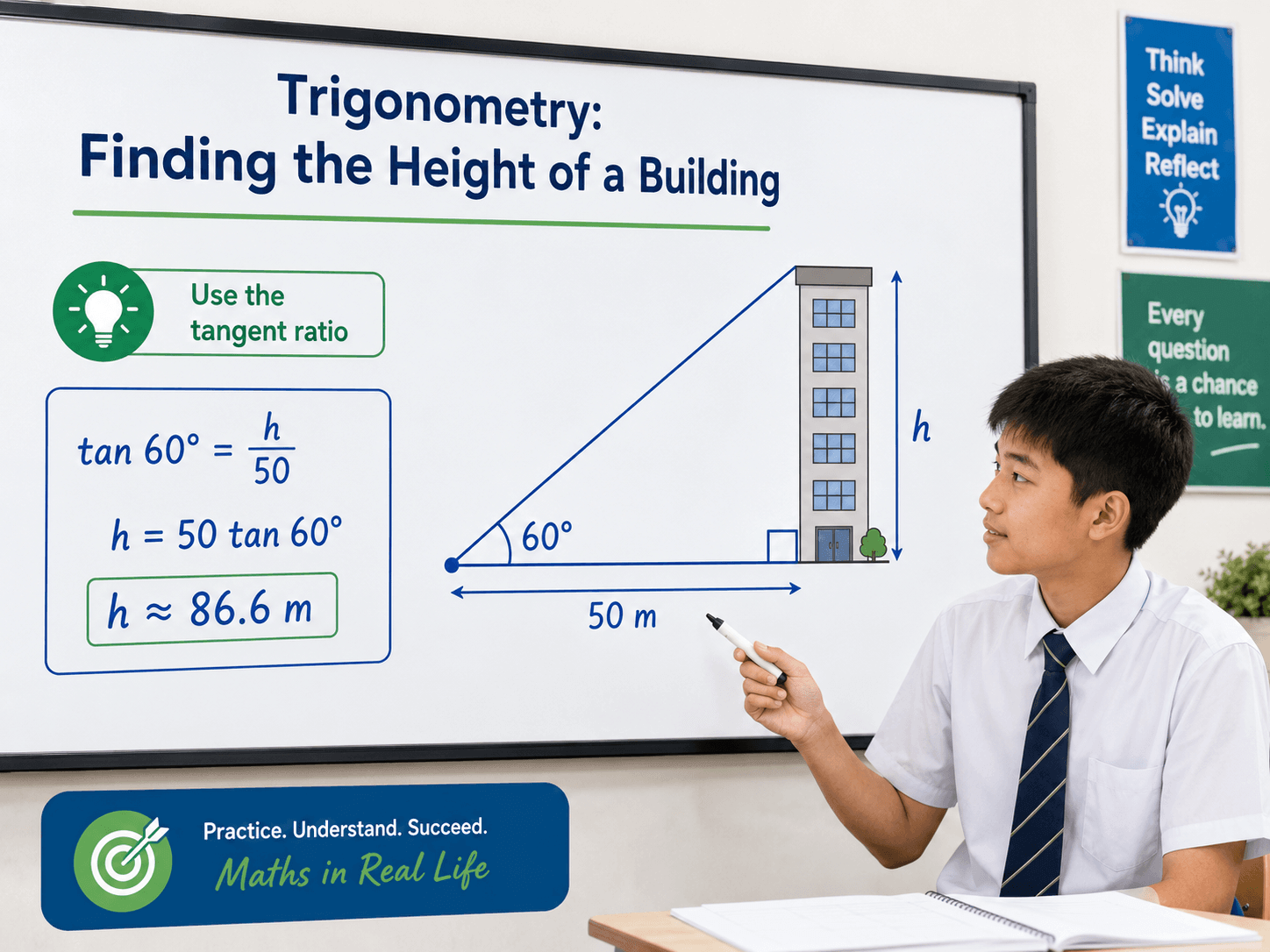
In this example, we know the distance from the observer to the building is \(50\text{ m}\), and the angle of elevation is \(60^\circ\). Using trigonometry, we can calculate the height of the building by choosing the correct ratio.
For many students, trigonometry height questions feel confusing at first. But once you identify the opposite side, adjacent side, and the correct trigonometric ratio, the working becomes much clearer.
The Question / Scenario Explanation
Source: Ever wondered how tall a building is without climbing it or using a measuring tape?
The screenshots show a person standing \(50\text{ m}\) away from a building. The angle of elevation from the person to the top of the building is \(60^\circ\).
The question is asking us to find the height of the building.
From the diagram:
- The horizontal distance from the person to the building is \(50\text{ m}\).
- The angle of elevation is \(60^\circ\).
- The unknown building height is \(h\).
This forms a right-angled triangle. Since we are given the adjacent side and need to find the opposite side, we should use the tangent ratio.
Step-by-Step Solution / Explanation
Step 1: Identify the Right-Angled Triangle
Trigonometry is used when we have a right-angled triangle. In this situation, the ground, the building, and the line of sight to the top of the building form a right-angled triangle.
The building is vertical, the ground is horizontal, and they meet at a right angle.
Step 2: Label the Known and Unknown Sides
We are given:
- Angle of elevation: \(60^\circ\)
- Distance from observer to building: \(50\text{ m}\)
- Height of building: \(h\)
From the \(60^\circ\) angle:
- The side opposite the angle is the building height, \(h\).
- The side next to the angle is the ground distance, \(50\text{ m}\).
This tells us that we are working with the opposite and adjacent sides.
Step 3: Choose the Correct Trigonometric Ratio
The tangent ratio connects the opposite side and adjacent side:
\( \tan \theta = \frac{\text{opposite}}{\text{adjacent}} \)
Since we know the adjacent side and need to find the opposite side, tangent is the correct ratio to use.
Step 4: Substitute the Values
Using the formula:
\( \tan 60^\circ = \frac{h}{50} \)
Now multiply both sides by \(50\):
\( h = 50 \times \tan 60^\circ \)
Step 5: Calculate the Height
Using a calculator:
\( \tan 60^\circ \approx 1.732 \)
So:
\( h = 50 \times 1.732 \)
\( h \approx 86.6 \)
Therefore, the height of the building is approximately:
\(86.6\text{ m}\)
Step 6: State the Final Answer Clearly
The final answer is:
The building is approximately \(86.6\text{ m}\) tall.
In exam questions, remember to include the unit and round the answer according to the question requirement.
Key Concepts Students Must Know
- Angle of elevation: This is the angle measured upwards from the horizontal line of sight.
- Right-angled triangle: Trigonometry ratios are used with right-angled triangles.
- Opposite side: The side directly across from the given angle.
- Adjacent side: The side next to the given angle, excluding the hypotenuse.
- Tangent ratio: \( \tan \theta = \frac{\text{opposite}}{\text{adjacent}} \).
- Real-life application: Trigonometry can be used to estimate heights and distances that are difficult to measure directly.
Exam Tips / Common Mistakes
Exam Tips
- Always draw or label the right-angled triangle clearly.
- Mark the given angle before deciding which sides are opposite and adjacent.
- Use tangent when the question involves opposite and adjacent sides.
- Check that your calculator is in degree mode for angles like \(60^\circ\).
- Include the final unit, such as metres or centimetres.
Common Mistakes
- Using sine or cosine instead of tangent.
- Labelling the opposite and adjacent sides wrongly.
- Forgetting to multiply by \(50\) after setting up \( \tan 60^\circ = \frac{h}{50} \).
- Using radian mode instead of degree mode on the calculator.
- Leaving out the unit in the final answer.
For trigonometry height questions, the most important step is choosing the correct ratio. Once the ratio is correct, the calculation is usually straightforward.
Parent Insight
Trigonometry can feel abstract to students if they only see formulas. However, examples like finding the height of a building help students see why the topic is useful.
Parents can support their child by encouraging them to explain the triangle before calculating. For example, ask:
- “Where is the right angle?”
- “Which side is opposite the \(60^\circ\) angle?”
- “Which side is adjacent to the angle?”
- “Why are we using tangent instead of sine or cosine?”
These questions help students think through the concept instead of memorising formulas blindly. This is especially helpful for Secondary and O Level Maths preparation.
Conclusion
Trigonometry height questions become easier when students identify the triangle, label the sides correctly, and choose the right ratio.
In this example, the angle of elevation is \(60^\circ\), the adjacent distance is \(50\text{ m}\), and the unknown height is \(h\). Since we are using opposite and adjacent sides, we apply tangent:
\( \tan 60^\circ = \frac{h}{50} \)
This gives:
\( h \approx 86.6\text{ m} \)
With regular practice, students can solve trigonometry height questions more confidently and see how Maths applies to real-life situations.
Visit our homepage: Click Here…
Read more on our blog: Click Here…
Start here (limited slots weekly):
Free Trial: Click Here…
Enroll: Click Here…
Explore our main tuition brand approach here: Click Here… .