Introduction
Simultaneous equations are a key part of Secondary Maths. Students are required to solve two equations together in order to find the values of two unknowns, usually \(x\) and \(y\).
One of the most reliable methods is the elimination method. The main idea is simple: make one variable cancel out so that only one unknown remains. Then solve for that unknown and substitute the value back into one of the original equations.
In this example, we will solve the pair of equations \(2x + 3y = 8\) and \(3x – y = 23\) step by step.
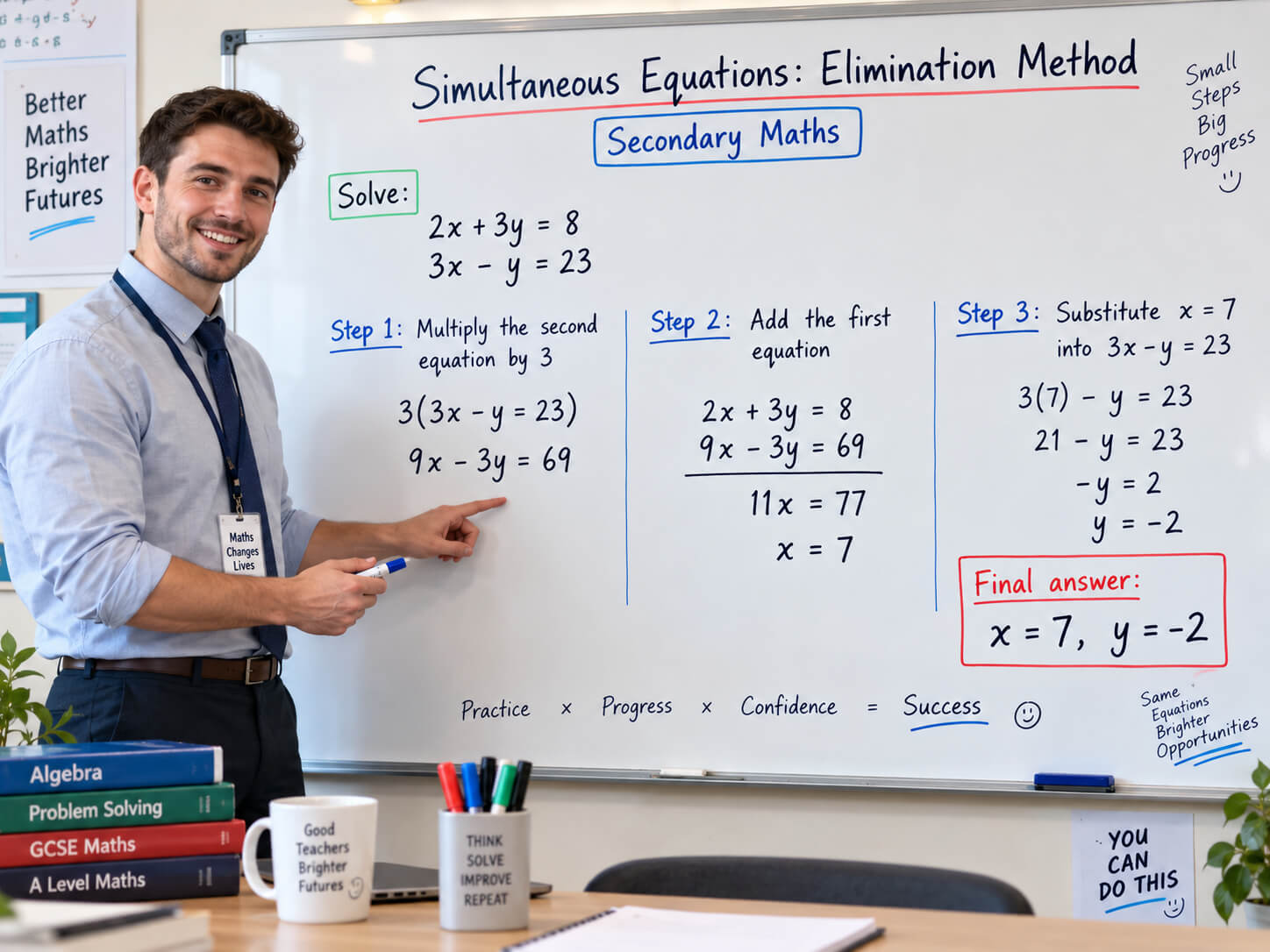
The Question / Scenario Explanation
Source: Solving simultaneous equations: \(2x + 3y = 8\) and \(3x – y = 23\).
The equations are:
\( 2x + 3y = 8 \) …(1)
\( 3x – y = 23 \) …(2)
We want to find the values of both \(x\) and \(y\).
Since there are two equations and two unknowns, we can use the elimination method. We will eliminate one variable first, solve for the other, and then substitute back.
Step-by-Step Solution / Explanation
Step 1: Decide Which Variable to Eliminate
We compare the two equations:
\( 2x + 3y = 8 \)
\( 3x – y = 23 \)
The \(y\)-terms are \(+3y\) and \(-y\). Since \(3y\) and \(-3y\) would cancel nicely, it is convenient to eliminate \(y\).
Step 2: Make the y-Terms the Same Magnitude
To change \(-y\) into \(-3y\), multiply the whole of equation (2) by \(3\):
\( 3(3x – y) = 3(23) \)
This gives:
\( 9x – 3y = 69 \) …(3)
Now compare equation (1) and equation (3):
\( 2x + 3y = 8 \)
\( 9x – 3y = 69 \)
Step 3: Add the Equations to Eliminate y
Add equation (1) and equation (3):
\( (2x + 3y) + (9x – 3y) = 8 + 69 \)
The \(+3y\) and \(-3y\) cancel:
\( 11x = 77 \)
Step 4: Solve for x
Now divide both sides by \(11\):
\( x = \frac{77}{11} \)
\( x = 7 \)
So we have found:
\( x = 7 \)
Step 5: Substitute x = 7 into One Original Equation
Now substitute \(x = 7\) into equation (2):
\( 3x – y = 23 \)
Substitute \(x = 7\):
\( 3(7) – y = 23 \)
\( 21 – y = 23 \)
Step 6: Solve for y
Subtract \(21\) from both sides:
\( -y = 23 – 21 \)
\( -y = 2 \)
Multiply both sides by \(-1\):
\( y = -2 \)
So we have found:
\( y = -2 \)
Step 7: State the Final Answer
The solution to the simultaneous equations is:
\( x = 7,\quad y = -2 \)
Step 8: Check the Answer
Substitute \(x=7\) and \(y=-2\) into equation (1):
\( 2(7) + 3(-2) = 14 – 6 = 8 \)
This matches the right-hand side.
Now check equation (2):
\( 3(7) – (-2) = 21 + 2 = 23 \)
This also matches the right-hand side.
So the solution is correct.
Key Concepts Students Must Know
- Simultaneous equations involve solving two equations together to find the values of two unknowns.
- The elimination method works by making one variable cancel out.
- When multiplying an equation, every term on both sides must be multiplied.
- After finding one variable, substitute it back into one of the original equations to find the other.
- Always check the final values in both equations.
Exam Tips / Common Mistakes
Exam Tips
- Choose the variable that is easiest to eliminate first.
- Write equation numbers clearly, such as (1), (2), and (3), so your working is organised.
- When multiplying an equation, multiply every term, not just one part of it.
- After solving for one variable, substitute carefully and keep track of signs.
- Do a quick check at the end to confirm both equations are satisfied.
Common Mistakes
- Forgetting to multiply the constant on the right-hand side: When multiplying equation (2) by \(3\), \(23\) must also become \(69\).
- Sign errors: Students may forget that subtracting a negative changes the sign.
- Cancelling incorrectly: Only like terms can be combined or cancelled.
- Stopping after finding x: In simultaneous equations, you must find both \(x\) and \(y\).
- Not checking the answer: A quick substitution can catch careless mistakes before the examiner does.
Parent Insight
Many students struggle with simultaneous equations not because the idea is too difficult, but because they lose track of their working. This topic rewards neat layout and step-by-step thinking.
Parents can help by encouraging children to slow down and structure their solution clearly. For example, ask them to label the equations, state which variable they want to eliminate, and explain why they are multiplying an equation by a certain number.
This helps students understand the logic of the elimination method instead of just memorising a procedure.
Conclusion
To solve the simultaneous equations \(2x + 3y = 8\) and \(3x – y = 23\), we used the elimination method.
By multiplying the second equation by \(3\), we created \(-3y\), which cancelled with \(+3y\) in the first equation.
This allowed us to solve:
\( 11x = 77 \)
So:
\( x = 7 \)
Substituting \(x = 7\) into one of the original equations gave:
\( y = -2 \)
Therefore, the final answer is:
\( x = 7,\quad y = -2 \)
Visit our homepage: Click Here…
Read more on our blog: Click Here…
Start here (limited slots weekly):
Free Trial: Click Here…
Enrol: Click Here…
Explore our main tuition brand approach here: Click Here…