Introduction
Many students find simultaneous equations intimidating at first because there are two unknowns and more than one equation to handle. However, once students follow a clear method, these questions become much more manageable.
In O Level Maths, simultaneous equations often test whether students can organise their working carefully, eliminate one variable correctly, and substitute their answer back accurately. This means method marks are just as important as the final answer.
In this example, we will solve a pair of linear simultaneous equations step by step using the elimination method.
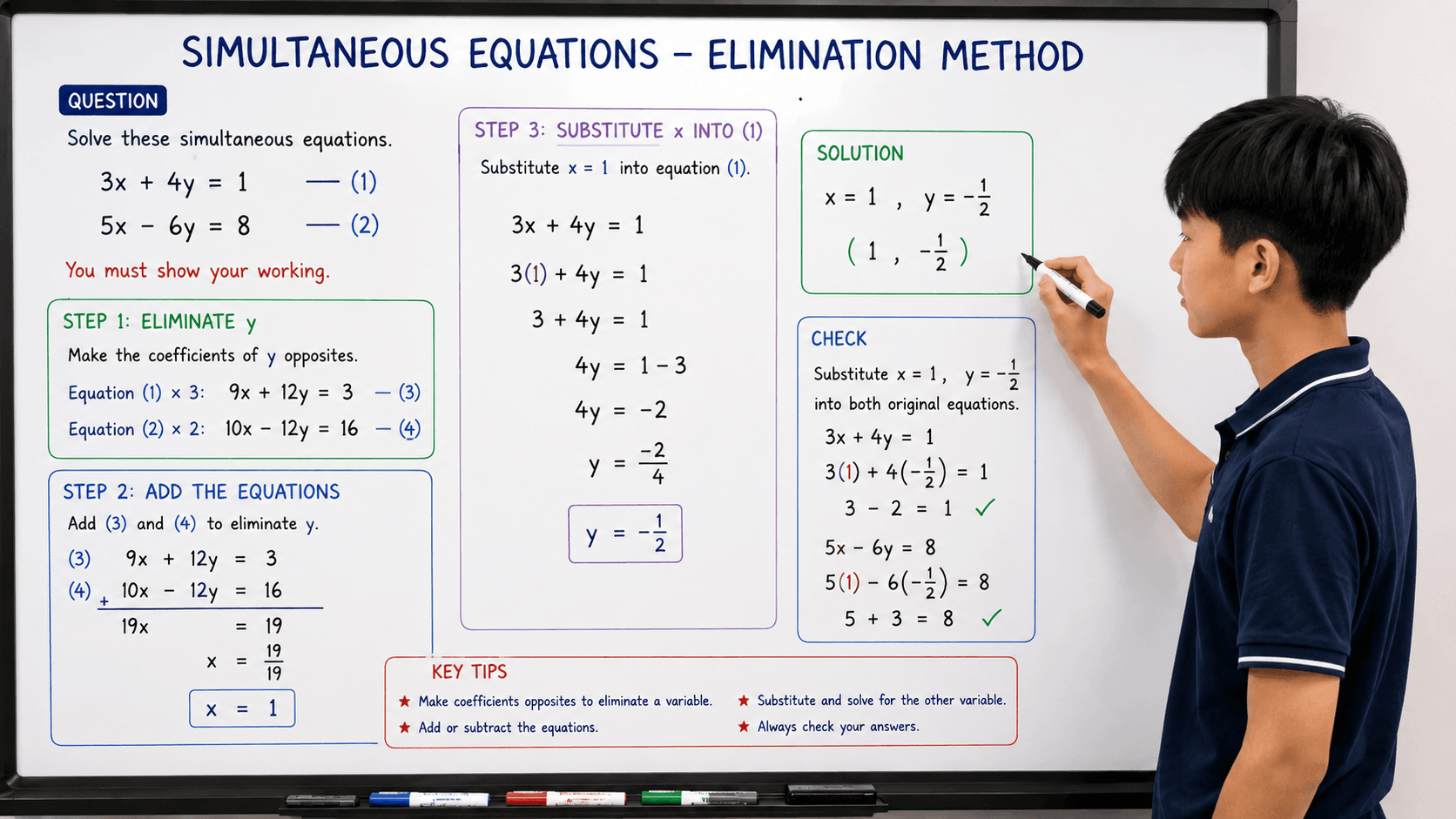
The Question / Scenario Explanation
Source: Simultaneous O Level 2025 Paper 2 Maths
The question is:
\( 3x + 4y = 1 \)
\( 5x – 6y = 8 \)
We are told to show our working. This is an important instruction because, in O Level Maths, students can earn method marks even if they make a small mistake later.
The goal is to find the values of both \(x\) and \(y\). A clear way to do this is to use the elimination method. This means changing the equations so that one variable cancels out when the equations are added or subtracted.
Step-by-Step Solution / Explanation
Step 1: Label the Equations
First, label the two equations so your working is organised:
\( 3x + 4y = 1 \) — (1)
\( 5x – 6y = 8 \) — (2)
This helps you refer back to each equation clearly when you substitute later.
Step 2: Decide Which Variable to Eliminate
We want the coefficients of one variable to become equal in magnitude so they can cancel out.
Looking at the \(y\)-terms:
- Equation (1) has \(+4y\)
- Equation (2) has \(-6y\)
The lowest common multiple of \(4\) and \(6\) is \(12\), so we will change both equations so that the \(y\)-terms become \(+12y\) and \(-12y\).
Step 3: Multiply Each Equation
Multiply equation (1) by \(3\):
\( 3(3x + 4y = 1) \)
\( 9x + 12y = 3 \) — (3)
Multiply equation (2) by \(2\):
\( 2(5x – 6y = 8) \)
\( 10x – 12y = 16 \) — (4)
Now the \(y\)-terms are opposites, so they can be eliminated.
Step 4: Add the New Equations
Add equations (3) and (4):
\( 9x + 12y = 3 \)
\( 10x – 12y = 16 \)
Adding them gives:
\( 19x = 19 \)
Now solve for \(x\):
\( x = \frac{19}{19} = 1 \)
So,
\( x = 1 \)
Step 5: Substitute Back to Find y
Now substitute \(x = 1\) into either original equation. Using equation (1):
\( 3x + 4y = 1 \)
Substitute \(x = 1\):
\( 3(1) + 4y = 1 \)
\( 3 + 4y = 1 \)
\( 4y = 1 – 3 \)
\( 4y = -2 \)
\( y = -\frac{2}{4} = -\frac{1}{2} \)
So,
\( y = -\frac{1}{2} \)
Step 6: State the Final Answer Clearly
The final answer is:
\( x = 1 \), \( y = -\frac{1}{2} \)
Always write both values clearly, especially when the question asks you to solve the simultaneous equations fully.
Step 7: Quick Check
It is good practice to check your answer by substituting both values into the second original equation:
\( 5x – 6y = 8 \)
Substitute \(x = 1\) and \(y = -\frac{1}{2}\):
\( 5(1) – 6\left(-\frac{1}{2}\right) = 5 + 3 = 8 \)
The equation is true, so the solution is correct.
Key Concepts Students Must Know
- Simultaneous equations involve two or more equations: The solution must satisfy both equations at the same time.
- Elimination is a common method: Students make one variable cancel out by multiplying equations suitably.
- Substitution is the next step: Once one variable is found, it is substituted back to find the other variable.
- Working must be shown clearly: This is important for method marks in O Level Maths.
- Checking helps avoid careless mistakes: Substitute the final answers back into an original equation to verify them.
Exam Tips / Common Mistakes
Exam Tips
- Label your equations clearly as (1) and (2).
- Choose the variable that is easiest to eliminate.
- Show every multiplication step when changing the equations.
- After finding one variable, substitute back neatly into an original equation.
- Box or underline the final values of both unknowns.
Common Mistakes
- Multiplying one term correctly but forgetting to multiply the whole equation.
- Making sign errors when adding or subtracting equations.
- Finding \(x\) but forgetting to find \(y\).
- Substituting into the equation incorrectly.
- Writing the final answer without showing proper working.
For simultaneous equations, most mistakes happen because students rush through the elimination step or lose track of signs. Careful working makes a big difference.
Parent Insight
Parents often notice that their child understands the idea of simultaneous equations but still loses marks in tests. This usually happens because the child’s working is not organised enough.
At O Level, students need more than the right final answer. They need a clear structure: label the equations, eliminate one variable, substitute carefully, and state the final solution properly. Encouraging your child to write neatly and check each step can improve both accuracy and confidence.
When supporting revision at home, parents can ask simple questions such as:
- “Which variable are you eliminating first?”
- “Did you multiply the whole equation?”
- “Have you substituted back to find the other variable?”
- “Did you check your final answer?”
Conclusion
Simultaneous equations do not have to be overwhelming when students follow a step-by-step method. In this question, we used elimination to remove \(y\), found \(x = 1\), and then substituted back to get \(y = -\frac{1}{2}\).
The key to doing well is not just knowing the method, but showing the working clearly and checking the answer carefully. With enough practice, this becomes a very reliable O Level Maths skill.
Visit our homepage: Click Here…
Read more on our blog: Click Here…
Start here (limited slots weekly):
Free Trial: Click Here…
Enroll: Click Here…
Explore our main tuition brand approach here: Click Here… .