Introduction
The quadratic turning point is one of the most important features of a quadratic graph. It is the exact point where the graph changes direction.
For Secondary Maths students, there is a quick formula that helps you find the x-coordinate of the turning point without plotting many points first:
\( x = \frac{-b}{2a} \)
Once you find the x-value, you simply substitute it back into the equation to get the y-value. This makes finding the quadratic turning point much faster and more reliable in exams.
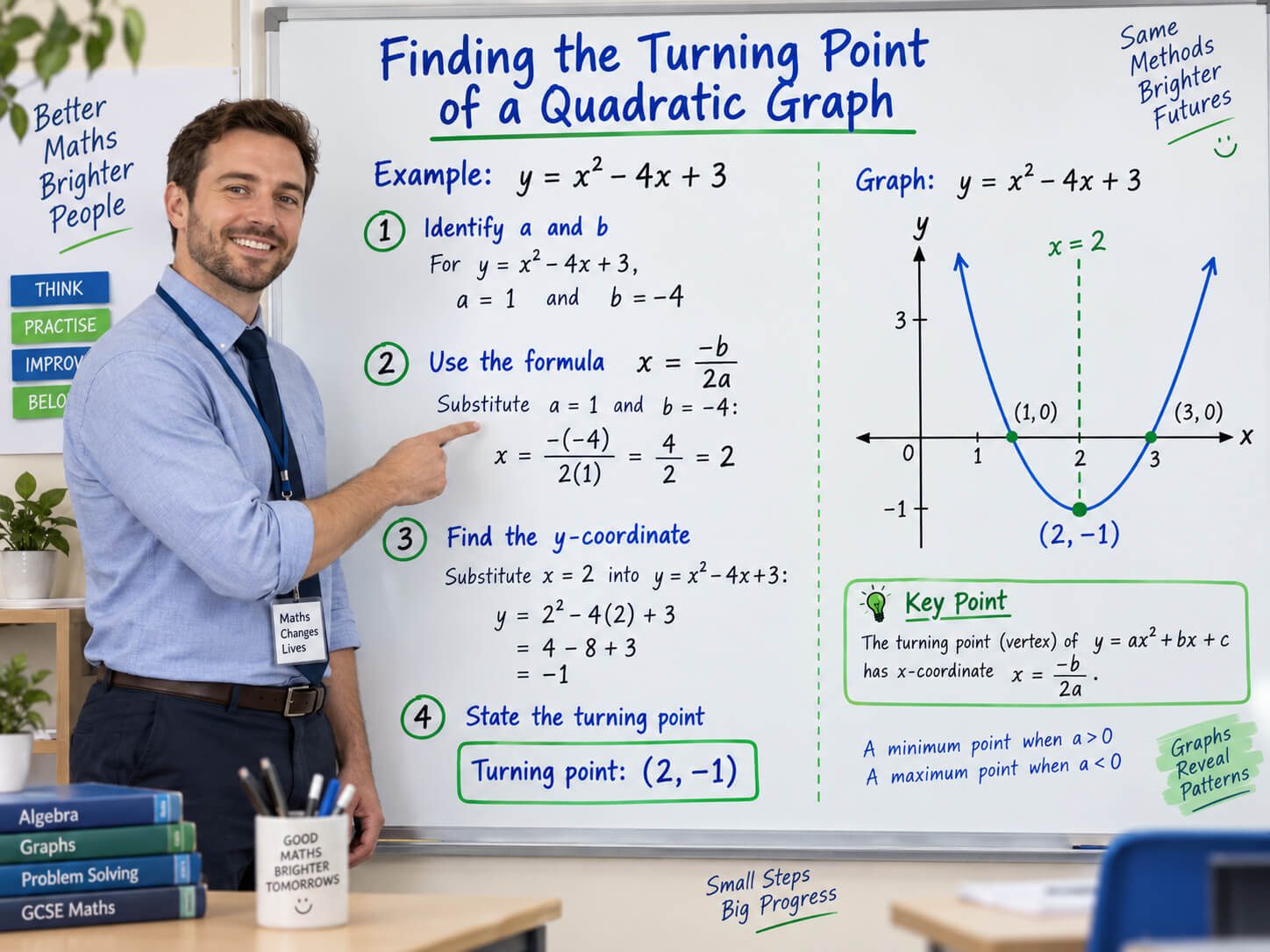
The Question / Scenario Explanation
Source: Find any quadratic’s turning point with \( x = \frac{-b}{2a} \).
We are given the quadratic equation:
\( y = x^2 – 4x + 3 \)
We want to find its turning point.
For any quadratic in the form:
\( y = ax^2 + bx + c \)
the x-coordinate of the turning point is:
\( x = \frac{-b}{2a} \)
After finding the x-coordinate, substitute it back into the equation to find the y-coordinate.
This gives the full coordinates of the quadratic turning point.
Step-by-Step Solution / Explanation
Step 1: Identify a and b
We compare:
\( y = x^2 – 4x + 3 \)
with the general form:
\( y = ax^2 + bx + c \)
So:
\( a = 1 \)
\( b = -4 \)
\( c = 3 \)
To use the turning point formula, we only need \(a\) and \(b\) first.
Step 2: Use the Formula for the x-Coordinate
The formula is:
\( x = \frac{-b}{2a} \)
Substitute \(a = 1\) and \(b = -4\):
\( x = \frac{-(-4)}{2(1)} \)
\( x = \frac{4}{2} \)
\( x = 2 \)
So the x-coordinate of the turning point is \(2\).
Step 3: Substitute x = 2 Back into the Equation
Now substitute \(x = 2\) into:
\( y = x^2 – 4x + 3 \)
\( y = 2^2 – 4(2) + 3 \)
\( y = 4 – 8 + 3 \)
\( y = -1 \)
So the y-coordinate is \(-1\).
Step 4: State the Turning Point
The turning point is:
\( \boxed{(2, -1)} \)
This is the full quadratic turning point for the graph \( y = x^2 – 4x + 3 \).
Step 5: Decide Whether the Graph Is Happy or Sad
Now look at the coefficient of \(x^2\).
In:
\( y = x^2 – 4x + 3 \)
the coefficient of \(x^2\) is positive.
This means the graph opens upward. Many students remember this as a happy graph or a smiling graph.
So the turning point \((2, -1)\) is the lowest point of the graph.
Step 6: Try the Challenge Question
The video also asks students to find the turning point of:
\( y = 2x^2 – 8x + 5 \)
First identify:
\( a = 2 \)
\( b = -8 \)
Now use the formula:
\( x = \frac{-(-8)}{2(2)} \)
\( x = \frac{8}{4} \)
\( x = 2 \)
Substitute \(x = 2\) back into the equation:
\( y = 2(2^2) – 8(2) + 5 \)
\( y = 2(4) – 16 + 5 \)
\( y = 8 – 16 + 5 \)
\( y = -3 \)
So the turning point is:
\( \boxed{(2, -3)} \)
Since the coefficient of \(x^2\) is \(2\), which is positive, this is also a happy graph.
Step 7: Understand Why This Formula Matters
In exam questions, students are often asked to sketch graphs, identify maximum or minimum points, or solve problems involving quadratic functions.
Knowing how to find the quadratic turning point quickly helps with all of these.
It also saves time because you do not need to guess the turning point from a table of values.
Key Concepts Students Must Know
- A quadratic equation is usually written as \( y = ax^2 + bx + c \).
- The x-coordinate of the turning point is found using \( x = \frac{-b}{2a} \).
- After finding x, substitute it back into the equation to find y.
- The turning point is a coordinate, so your final answer must include both x and y values.
- If \(a\) is positive, the graph opens upward and the turning point is a minimum point.
- If \(a\) is negative, the graph opens downward and the turning point is a maximum point.
Exam Tips / Common Mistakes
Exam Tips
- Always identify \(a\) and \(b\) carefully before using the formula.
- Use brackets when substituting negative values, especially for \(b\).
- After finding the x-coordinate, do not stop there. Substitute back to find y.
- Check the sign of the \(x^2\) term to decide whether the graph is a maximum or minimum graph.
- Write the final turning point as coordinates, for example \((2, -1)\).
Common Mistakes
- Using the wrong value of b: In \( y = x^2 – 4x + 3 \), \(b = -4\), not \(4\).
- Forgetting the negative sign in the formula: The formula is \( \frac{-b}{2a} \), not \( \frac{b}{2a} \).
- Finding only x and forgetting y: The turning point needs both coordinates.
- Not using brackets: Writing \(-(-8)\) correctly avoids sign mistakes.
- Mixing up happy and sad graphs: Positive \(x^2\) means upward opening, negative \(x^2\) means downward opening.
Parent Insight
Many students think graph questions are mainly about drawing, but the stronger students usually rely on key formulas and structure. The turning point formula is one of those high-value tools.
When children understand that the turning point is the place where the graph changes direction, they become more confident with sketching graphs and interpreting them. It is not just a formula to memorise. It is a way to understand the graph’s most important feature.
Parents can help by asking simple questions such as, “What are a and b?” or “Is this graph opening up or down?” These small habits build clarity and reduce careless mistakes.
Conclusion
To find the quadratic turning point, use the formula:
\( x = \frac{-b}{2a} \)
Then substitute that x-value back into the equation to find y.
For:
\( y = x^2 – 4x + 3 \)
we get:
\( x = 2 \)
and:
\( y = -1 \)
So the turning point is:
\( \boxed{(2, -1)} \)
For the challenge question:
\( y = 2x^2 – 8x + 5 \)
the turning point is:
\( \boxed{(2, -3)} \)
and it is a happy graph because the coefficient of \(x^2\) is positive.
Visit our homepage: Click Here…
Read more on our blog: Click Here…
Start here (limited slots weekly):
Free Trial: Click Here…
Enrol: Click Here…
Explore our main tuition brand approach here: Click Here…