Introduction
This nearest whole number question is a useful lower secondary Maths example because students must evaluate a calculator expression carefully and then round correctly at the end. Many students can type the expression into the calculator, but they still lose marks in a nearest whole number question because they enter the brackets wrongly or round too early.
The Question / Scenario Explanation
Source: Numbers Sec 1 G2 and G3
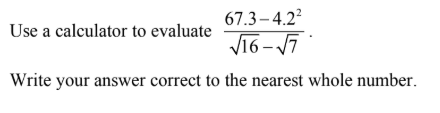
Question (as shown): Use a calculator to evaluate
\(\frac{67.3 – 4.2^2}{\sqrt{16} – \sqrt{7}}\)
Write your answer correct to the nearest whole number.
Step-by-Step Solution / Explanation
Step 1: Work out the numerator carefully
First calculate the square term:
\(4.2^2 = 17.64\)
Now subtract from \(67.3\):
\(67.3 – 17.64 = 49.66\)
So the numerator is \(49.66\).
Step 2: Work out the denominator carefully
Now calculate the square roots:
\(\sqrt{16} = 4\)
\(\sqrt{7} \approx 2.6458\)
So the denominator is:
\(4 – \sqrt{7} \approx 4 – 2.6458 = 1.3542\)
Step 3: Divide the numerator by the denominator
Now evaluate the full expression:
\(\frac{49.66}{1.3542} \approx 36.67\)
This gives a decimal answer of about \(36.67\).
Step 4: Round to the nearest whole number
Since \(36.67\) has a decimal part of \(0.67\), we round up.
So, correct to the nearest whole number:
✅ Final Answer: \(37\)
Step 5: Calculator input tip
For this nearest whole number question, it is safer to type the full expression with brackets:
\((67.3 – 4.2^2) \div (\sqrt{16} – \sqrt{7})\)
This helps prevent calculator entry mistakes.
Key Concepts Students Must Know
- In a nearest whole number question, calculate the full value first before rounding.
- Use brackets properly when entering fractions into a calculator.
- Squares and square roots must be evaluated accurately before division.
- If the decimal part is \(0.5\) or more, round up to the next whole number.
- Do not round intermediate steps too early, or the final answer may be inaccurate.
Exam Tips / Common Mistakes
Exam Tips
- Type the numerator and denominator in separate brackets on the calculator.
- For a nearest whole number question, keep more decimal places until the final step.
- Check whether the question wants a decimal answer, fraction, or rounded whole number.
- Read the instruction line again before writing the final answer.
Common Mistakes
- Typing \(67.3 – 4.2^2 \div \sqrt{16} – \sqrt{7}\) without brackets.
- Rounding \(\sqrt{7}\) too early and getting a less accurate final answer.
- Stopping at \(36.67\) without rounding to the nearest whole number.
- Rounding down to \(36\) instead of up to \(37\).
Parent Insight
This nearest whole number question is a good reminder that calculator questions still test mathematical care and accuracy. Many students assume calculator work is easy, but they often lose marks through incorrect input or careless rounding. With regular practice, children become much more confident in handling calculator expressions and interpreting instructions correctly.
Conclusion
To solve this nearest whole number question, we first worked out the numerator \(67.3 – 4.2^2 = 49.66\), then the denominator \(\sqrt{16} – \sqrt{7} \approx 1.3542\). Dividing gives about \(36.67\), which rounds to \(37\). So the correct final answer is \(37\).
Visit our Secondary Maths homepage: Click Here…
Read more Secondary Maths worked examples here: Click Here…
Start here (limited slots weekly):
Free Trial: Click Here…
Enroll: Click Here…
Explore our main tuition brand approach here: Click Here… .