Introduction
Many Secondary students study hard, but still forget what they revised a few days later. This is why having a good Maths revision strategy is just as important as completing worksheets or watching lesson videos.
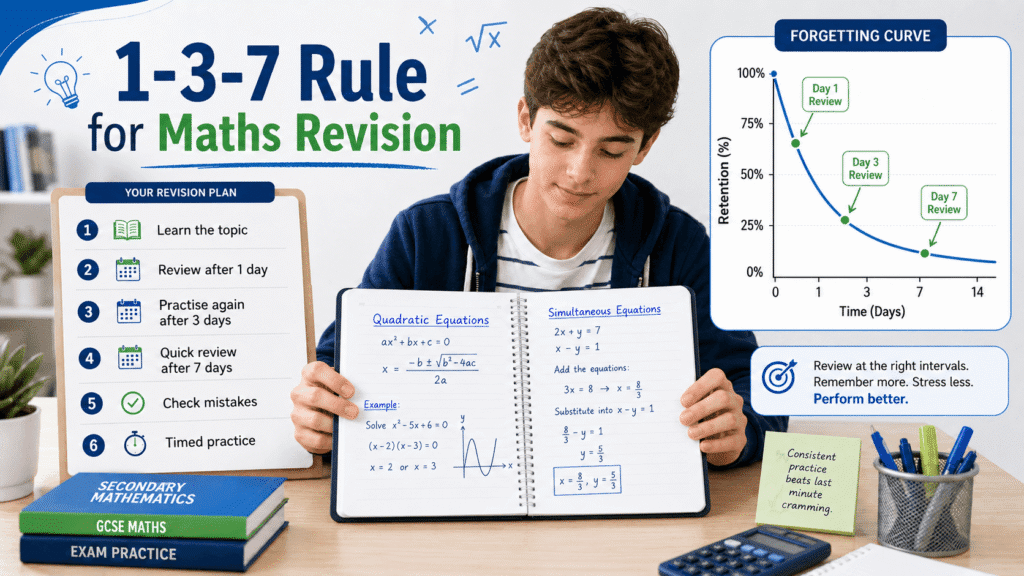
One powerful idea shown in the video is the forgetting curve. It explains how your brain naturally forgets information over time if you do not review it. For Secondary and O Level Maths students, this means topics like algebra, indices, geometry, trigonometry, and graphs can fade quickly if revision is not planned properly.
A simple way to solve this problem is to use the \(1\)-\(3\)-\(7\) rule. This Maths revision strategy helps students review at the right time so concepts stay fresh for tests and exams.
The Question / Scenario Explanation
Source: Your brain might be deleting what you studied
The video explains that our brain follows something called the forgetting curve. After learning something new, memory retention drops quickly if the student does not review the content again. Over time, the curve becomes flatter only when students revise regularly and intentionally.
The key solution shared is the \(1\)-\(3\)-\(7\) rule:
- Review after \(1\) day
- Review again after \(3\) days
- Review again after \(7\) days
Step-by-Step Solution / Explanation
Step 1: Understand the Forgetting Curve
The forgetting curve shows that students tend to forget information quickly soon after learning it. For example, if a student learns a new algebra method today but does not review it, they may only remember part of the method a few days later.
This is why some students say, “I understood it in class, but I forgot during the test.” The issue is not always lack of ability. Often, it is the lack of a proper Maths revision strategy.
Step 2: Review After 1 Day
The first review should happen after \(1\) day. This does not need to be long. A student can spend \(10\) to \(15\) minutes reviewing the lesson notes, redoing one example, or checking the mistakes made during class.
For example, after learning expansion such as \( (x + 3)(x + 5) \), the student should try a similar question the next day without looking at the solution first.
Step 3: Review After 3 Days
The second review should happen after \(3\) days. At this stage, students should test whether they can still remember the method without guidance.
For Maths, this can be done by attempting \(3\) to \(5\) related questions. If the student makes the same mistake again, that topic should be marked for further practice.
Step 4: Review After 7 Days
The third review should happen after \(7\) days. This review helps move the concept into longer-term memory.
For example, if the student learned factorisation this week, they should attempt a mixed practice question one week later. This is important because exams rarely test topics in the exact same way as class examples.
Step 5: Use the Rule Consistently
The \(1\)-\(3\)-\(7\) rule works best when students use it consistently. Instead of cramming everything the night before an exam, students build stronger recall through repeated review.
This Maths revision strategy is especially useful for Secondary and O Level students because Maths topics build on one another. Weak memory in one topic can affect performance in future chapters.
Key Concepts Students Must Know
- Forgetting is normal: Students should not feel discouraged if they forget. The brain needs repeated review to strengthen memory.
- Revision must be timed: Reviewing once is usually not enough. The \(1\)-\(3\)-\(7\) rule gives students a clear schedule.
- Active recall works better: Students should try questions without looking at notes first.
- Mistake review is essential: Repeating corrected questions helps students avoid the same exam errors.
- Maths needs practice: Understanding a concept is only the first step. Students must apply it in different question types.
Exam Tips / Common Mistakes
Exam Tips
- After each lesson, write down the topic and plan reviews on Day \(1\), Day \(3\), and Day \(7\).
- Keep a mistake notebook for careless errors, concept gaps, and repeated wrong methods.
- Use short revision blocks instead of waiting for one long revision session before exams.
- Redo questions that were previously wrong without looking at the solution.
- Mix old topics with current topics so earlier chapters are not forgotten.
Common Mistakes
- Only reading notes instead of attempting questions.
- Revising only when a test is near.
- Skipping topics that feel “easy” after one lesson.
- Not checking why a mistake happened.
- Doing many questions quickly but not learning from wrong answers.
A strong Maths revision strategy should include both understanding and repeated practice. Students need to know what went wrong, why it went wrong, and how to avoid it next time.
Parent Insight
Parents often see their child studying for long hours but still not getting the expected results. One reason is that the revision may not be structured. A child may complete many worksheets, but if older mistakes are not reviewed at the right time, the learning may fade.
The \(1\)-\(3\)-\(7\) rule gives parents a simple way to support their child’s revision routine. Instead of asking only, “Have you studied?”, parents can ask:
- “What did you review from yesterday’s lesson?”
- “Which question did you get wrong three days ago?”
- “Can you still solve last week’s topic without looking at your notes?”
This helps students become more responsible and aware of their own learning. For Secondary and O Level Maths, steady revision is often more effective than last-minute memorisation.
Conclusion
The forgetting curve reminds students that forgetting is part of learning. The solution is not to panic, but to review at the right intervals.
By using the \(1\)-\(3\)-\(7\) rule, students can remember concepts longer, reduce exam stress, and build confidence in Secondary Maths. A clear Maths revision strategy helps students turn short-term understanding into long-term exam readiness.
Visit our homepage: Click Here…
Read more on our blog: Click Here…
Start here (limited slots weekly):
Free Trial: Click Here…
Enrol: Click Here…
Explore our main tuition brand approach here: Click Here… .