Introduction
The 2 equals 1 proof is a classic algebra trick that often surprises students at first glance. Everything seems correct line by line, yet it somehow ends with the impossible statement that 2 equals 1.
In this example, Coach Irfan shows a fake proof and challenges students to spot the mistake. Questions like this are useful because they train students to think carefully about algebra rules instead of blindly following the working.
For Secondary and O Level E Maths students, understanding why this 2 equals 1 proof fails is an excellent way to strengthen algebraic reasoning and avoid common exam mistakes.
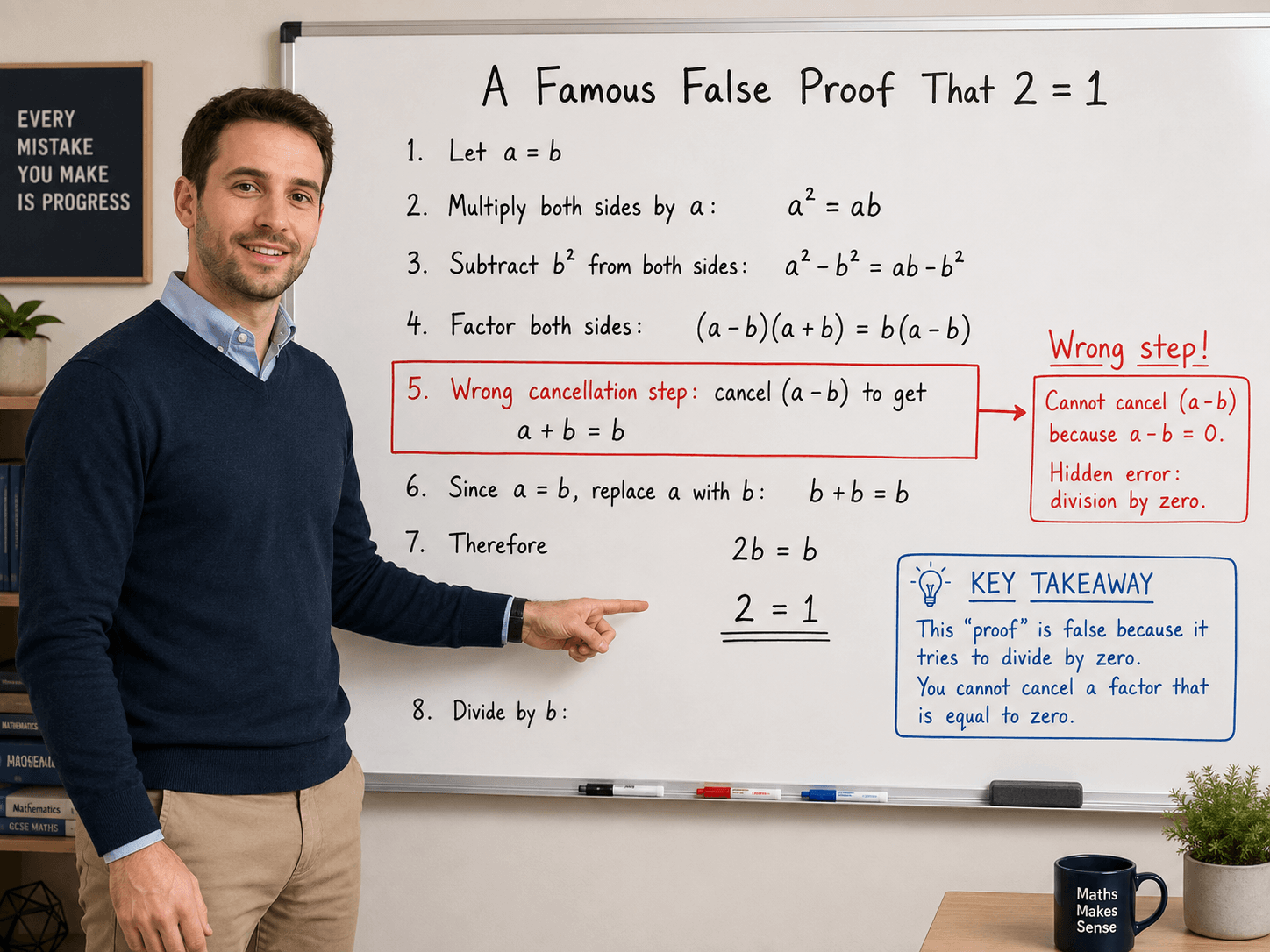
The Question / Scenario Explanation
Source: Coach Irfan “proves” 2 = 1 — can you spot the error?
This question is not asking students to believe that 2 really equals 1. Instead, it is asking them to analyse the algebra and identify the exact step where the logic breaks down.
The false proof usually starts by assuming that \( a = b \). From there, both sides are manipulated until it appears that \( 2 = 1 \).
A simplified version of the argument is shown below:
\( a = b \)
\( a^2 = ab \)
\( a^2 – b^2 = ab – b^2 \)
\( (a+b)(a-b) = b(a-b) \)
Cancel \( (a-b) \) from both sides:
\( a+b = b \)
Since \( a = b \), substitute \( a \) with \( b \):
\( b+b = b \)
\( 2b = b \)
Divide both sides by \( b \):
\( 2 = 1 \)
At first glance, every step may seem reasonable. However, one step is illegal.
Step-by-Step Solution / Explanation
Step 1: Start with the Given Statement
The false proof begins with:
\( a = b \)
This means that \( a \) and \( b \) have exactly the same value.
Step 2: Follow the Algebraic Manipulation
If we multiply both sides by \( a \), we get:
\( a^2 = ab \)
Then subtract \( b^2 \) from both sides:
\( a^2 – b^2 = ab – b^2 \)
Now factor both sides:
\( (a+b)(a-b) = b(a-b) \)
Up to this point, the algebra is still valid.
Step 3: Identify the Dangerous Step
The false proof then cancels \( (a-b) \) on both sides and writes:
\( a+b = b \)
This is the exact step where the error happens.
Why? Because from the original statement \( a = b \), we know that:
\( a-b = 0 \)
So the expression \( (a-b) \) is actually zero.
That means the cancellation step is really dividing both sides by zero, which is not allowed in mathematics.
Step 4: Explain Why Division by Zero Is Invalid
Division by zero is undefined. In algebra, you may only cancel a common factor if that factor is definitely not zero.
Here, since \( a-b = 0 \), the step
\( (a+b)(a-b) = b(a-b) \)
to
\( a+b = b \)
is invalid.
So the rest of the proof collapses because it is built on an illegal step.
Step 5: State the Final Conclusion Clearly
The statement \( 2 = 1 \) is false.
The so-called 2 equals 1 proof works only because it secretly divides by zero when cancelling \( (a-b) \).
Final Answer: The error is the cancellation of \( (a-b) \) when \( a-b = 0 \).
Key Concepts Students Must Know
- Equal values give zero difference: If \( a = b \), then \( a-b = 0 \).
- Division by zero is undefined: You cannot divide or cancel a factor that is equal to zero.
- Cancellation has conditions: Common factors can only be cancelled when they are non-zero.
- Algebra must remain logically valid: One illegal step can make the final answer completely meaningless.
- Always question “impossible” results: If working leads to something absurd like \( 2 = 1 \), there must be an error earlier.
This type of question is especially useful because it develops mathematical alertness, not just mechanical solving skills.
Exam Tips / Common Mistakes
Exam Tips
- Whenever you cancel a factor, check whether that factor could be zero.
- If a result looks impossible, go back and inspect every step carefully.
- Write down the implication of the given statement clearly. For example, from \( a = b \), note immediately that \( a-b = 0 \).
- In algebra questions, do not assume every shown step is correct just because it looks neat.
- Train yourself to justify each manipulation, especially division and cancellation.
Common Mistakes
- Cancelling zero: Students may cancel \( (a-b) \) without realising it is zero.
- Ignoring the original condition: Forgetting that \( a = b \) leads directly to \( a-b = 0 \).
- Trusting the final line too quickly: Seeing a dramatic result like \( 2 = 1 \) and not checking whether the logic is valid.
- Thinking the factor is “common so it can always be cancelled”: A common factor can only be cancelled if it is not zero.
- Confusing valid factorisation with valid cancellation: The factorisation step is fine here; the cancellation step is not.
Parent Insight
Parents may notice that some algebra questions are less about calculation and more about reasoning. This is one of those questions.
The value of this example is that it teaches students to be careful, logical and disciplined when handling equations. These habits are important not only for Secondary Maths but also for higher-level algebra later on.
If your child often rushes through working, questions like this can help them slow down and understand that every algebra step must be justified.
Conclusion
The 2 equals 1 proof is wrong because it contains a hidden division by zero. Since \( a = b \), we have \( a-b = 0 \), so cancelling \( (a-b) \) is not allowed.
This example is a strong reminder that correct-looking algebra can still be wrong if one step breaks a mathematical rule. Students should always check whether a factor being cancelled could be zero.
Developing this habit helps students become more accurate and more confident in algebraic manipulation.
Visit our homepage: Click Here…
Read more on our blog: Click Here…
Start here (limited slots weekly):
Free Trial: Click Here…
Enroll: Click Here…
Explore our main tuition brand approach here: Click Here…