Introduction
This difference of squares question is a key lower secondary algebra skill that students should recognise quickly. Many students try to expand or guess factors, but this type of expression follows a standard pattern. Once you spot the difference of squares form, factorisation becomes fast and systematic.
The Question / Scenario Explanation
Source: Factorisation Sec 2 G3
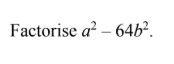
Question (as shown): Factorise \(a^2 – 64b^2\).
Step-by-Step Solution / Explanation
Step 1: Recognise the difference of squares pattern
This expression is:
\(a^2 – 64b^2\)
We can rewrite \(64b^2\) as:
\((8b)^2\)
So the expression becomes:
\(a^2 – (8b)^2\)
This is now clearly in the difference of squares form:
\(x^2 – y^2\)
Step 2: Apply the formula
The standard formula is:
\(x^2 – y^2 = (x+y)(x-y)\)
Here, \(x = a\) and \(y = 8b\).
So:
\(a^2 – (8b)^2 = (a+8b)(a-8b)\)
✅ Final Answer: \((a+8b)(a-8b)\)
Step 3: Quick check
Expand the factors:
\((a+8b)(a-8b)\)
\(= a^2 – 8ab + 8ab – 64b^2\)
\(= a^2 – 64b^2\)
So the factorisation is correct.
Key Concepts Students Must Know
- A difference of squares has the form \(x^2 – y^2\).
- The factorisation formula is \(x^2 – y^2 = (x+y)(x-y)\).
- Before factorising, check whether each term is a perfect square.
- \(64b^2\) is a perfect square because \(64b^2 = (8b)^2\).
- This pattern only works when there is subtraction, not addition.
Exam Tips / Common Mistakes
Exam Tips
- Always check if both terms are perfect squares first.
- In a difference of squares question, rewrite the second term clearly if needed, such as \(64b^2 = (8b)^2\).
- Memorise the formula \(x^2 – y^2 = (x+y)(x-y)\).
- Do a quick expansion check if you are unsure.
Common Mistakes
- Writing \((a+64b)(a-64b)\), which is incorrect because \(64b^2 = (8b)^2\), not \((64b)^2\).
- Trying to factorise it as \((a-8b)^2\), which would expand differently.
- Forgetting that the pattern is for subtraction, not addition.
- Not recognising \(64b^2\) as a perfect square term.
Parent Insight
This difference of squares question may look simple, but it is an important algebra foundation for secondary Maths. Students who recognise standard factorisation patterns quickly become more confident in algebra and make fewer careless mistakes. With regular practice, these patterns become automatic and save a lot of exam time.
Conclusion
To factorise this difference of squares expression, we first rewrote \(64b^2\) as \((8b)^2\). Then we used the formula \(x^2 – y^2 = (x+y)(x-y)\). So the correct factorisation of \(a^2 – 64b^2\) is \((a+8b)(a-8b)\).
Visit our Secondary Maths homepage: Click Here…
Read more Secondary Maths worked examples here: Click Here…
Start here (limited slots weekly):
Free Trial: Click Here…
Enroll: Click Here…
Explore our main tuition brand approach here: Click Here… .