Introduction
A square root equation may look complicated at first, but it becomes much easier when we simplify similar terms before solving for the unknown.
In this example, Coach Irfan explains how to solve \( \sqrt{x} + \sqrt{x} + \sqrt{x} + \sqrt{x} = 1 \). The key is to recognise that all four square root terms are identical.
By combining the terms carefully and squaring both sides at the correct stage, students can find the value of \(x\) confidently.
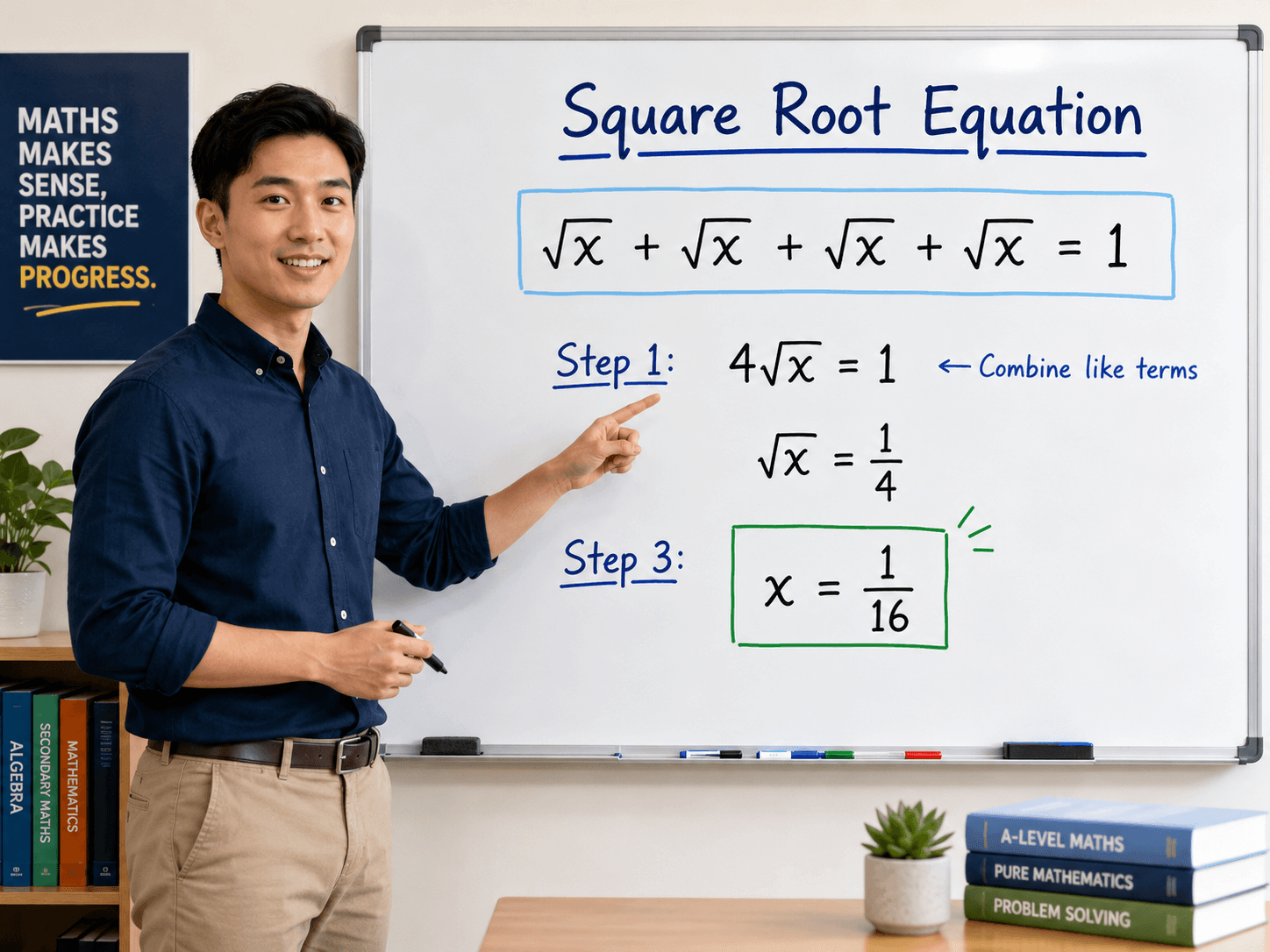
The Question / Scenario Explanation
Source: \( \sqrt{x} + \sqrt{x} + \sqrt{x} + \sqrt{x} = 1 \) — Coach Irfan solves this step by step.
Question:
\( \sqrt{x} + \sqrt{x} + \sqrt{x} + \sqrt{x} = 1 \)
Find the value of \(x\).
Each term on the left-hand side is exactly the same. Therefore, the four square root terms can be combined just like ordinary algebraic terms.
For example:
\( a + a + a + a = 4a \)
In the same way:
\( \sqrt{x} + \sqrt{x} + \sqrt{x} + \sqrt{x} = 4\sqrt{x} \)
Step-by-Step Solution / Explanation
Step 1: Combine the Identical Square Root Terms
Start with:
\( \sqrt{x} + \sqrt{x} + \sqrt{x} + \sqrt{x} = 1 \)
Since all four terms are identical, combine them:
\( 4\sqrt{x} = 1 \)
This is similar to combining like terms such as \( 4x + 3x = 7x \).
Step 2: Isolate the Square Root
Divide both sides of the equation by \(4\):
\( \frac{4\sqrt{x}}{4} = \frac{1}{4} \)
Therefore:
\( \sqrt{x} = \frac{1}{4} \)
The square root term is now isolated on the left-hand side.
Step 3: Square Both Sides
To remove the square root symbol, square both sides of the equation:
\( \left(\sqrt{x}\right)^2 = \left(\frac{1}{4}\right)^2 \)
The square and square root cancel each other:
\( x = \frac{1^2}{4^2} \)
\( x = \frac{1}{16} \)
Step 4: Check the Answer
Substitute \( x = \frac{1}{16} \) into the original equation.
\( \sqrt{\frac{1}{16}} = \frac{1}{4} \)
Therefore:
\( \frac{1}{4} + \frac{1}{4} + \frac{1}{4} + \frac{1}{4} = 1 \)
\( 1 = 1 \)
The equation is correct.
Final Answer: \( \boxed{x = \frac{1}{16}} \)
Key Concepts Students Must Know
- Like terms can be combined: Identical square root terms can be added by adding their coefficients.
- The coefficient matters: \( \sqrt{x} + \sqrt{x} + \sqrt{x} + \sqrt{x} \) becomes \( 4\sqrt{x} \), not \( \sqrt{4x} \).
- Use inverse operations: Divide by \(4\) before squaring both sides.
- Squaring removes a square root: \( \left(\sqrt{x}\right)^2 = x \).
- Square the entire fraction: \( \left(\frac{1}{4}\right)^2 = \frac{1}{16} \).
This square root equation tests both algebraic simplification and students’ understanding of indices and surds.
Exam Tips / Common Mistakes
Exam Tips
- Combine identical square root terms before trying to remove the square root.
- Write one algebraic step per line so that your working is easy to check.
- Isolate \( \sqrt{x} \) before squaring both sides.
- Use brackets when squaring a fraction: \( \left(\frac{1}{4}\right)^2 \).
- Substitute your final answer into the original equation to verify it.
Common Mistakes
- Incorrectly combining the terms: Writing \( \sqrt{4x} \) instead of \( 4\sqrt{x} \).
- Forgetting to divide by four: Students may square \( 4\sqrt{x} = 1 \) immediately without handling the coefficient carefully.
- Squaring only the denominator: \( \left(\frac{1}{4}\right)^2 \) means both the numerator and denominator are squared.
- Giving \(x = \frac{1}{4}\): This is the value of \( \sqrt{x} \), not the final value of \(x\).
- Skipping the checking step: A quick substitution can help identify careless mistakes.
Parent Insight
Questions like this help students build confidence in algebra because the solution depends on a few clear and repeatable steps.
If your child struggles with square roots, encourage them to identify the repeated terms first. They should then isolate the unknown expression before applying operations such as squaring.
Regular practice with short questions can strengthen the algebraic foundations needed for more challenging Secondary and O Level E Maths topics.
Conclusion
To solve the square root equation \( \sqrt{x} + \sqrt{x} + \sqrt{x} + \sqrt{x} = 1 \), first combine the four identical terms to obtain \( 4\sqrt{x} = 1 \).
Next, divide both sides by \(4\), giving \( \sqrt{x} = \frac{1}{4} \). Finally, square both sides to obtain \( x = \frac{1}{16} \).
The most important lesson is to simplify first, isolate the square root and only then square both sides.
Visit our Secondary and O Level E Maths tuition homepage: Explore SECMathsTuition
Read more Secondary Maths guides: Visit Our Maths Blog
Start with a free trial lesson: Register for a Free Trial
Enrol for weekly lessons: Enrol for Weekly Sessions
Learn more about the MasterMaths teaching approach: Visit MasterMaths .