Introduction
Many students learn prime numbers in school but wonder, “When will I ever use this in real life?” It may seem like a simple Maths topic, but prime numbers are actually very important in the digital world.
In Secondary Maths, students usually learn that a prime number can only be divided by \(1\) and itself. But beyond classroom questions, prime numbers are also used in encryption, data protection, and online security.
This means that the same concept students learn in Maths can help explain how passwords, online banking, and secure digital systems stay protected.
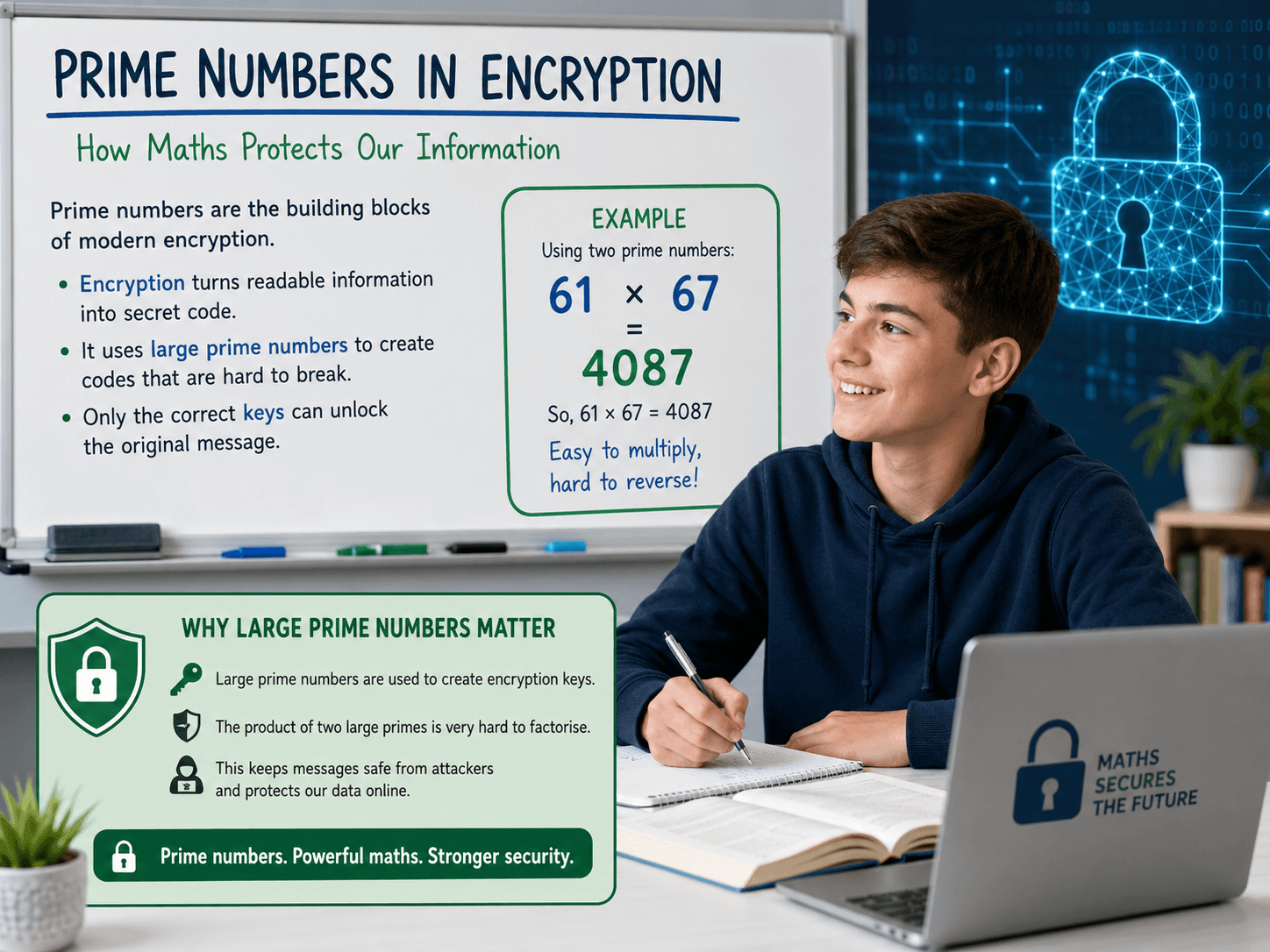
The Question / Scenario Explanation
Source: Ever wonder why prime numbers matter in real life?
The screenshots explain that a prime number can only be divided by \(1\) and itself. Examples include:
\(2,\ 3,\ 5,\ 7,\ 11,\ 13,\ 67\)
The video also explains a real-life link: prime numbers are used in encryption. Encryption helps protect information such as passwords, private messages, and online transactions.
A simple example shown is:
\(61 \times 67 = 4087\)
Multiplying two prime numbers is easy. But if someone only gives you \(4087\), finding the two original prime numbers can be much harder. This idea becomes extremely powerful when the prime numbers used are hundreds of digits long.
Step-by-Step Solution / Explanation
Step 1: Understand What a Prime Number Is
A prime number is a whole number greater than \(1\) that has exactly two factors:
- \(1\)
- itself
For example, \(7\) is a prime number because it can only be divided exactly by \(1\) and \(7\).
\(7 \div 1 = 7\)
\(7 \div 7 = 1\)
There are no other whole numbers that divide \(7\) exactly.
Step 2: Know Some Common Prime Numbers
Some common prime numbers are:
\(2,\ 3,\ 5,\ 7,\ 11,\ 13,\ 17,\ 19,\ 23,\ 29\)
Students should remember that \(2\) is the only even prime number. Every other even number can be divided by \(2\), so it has more than two factors and is not prime.
Step 3: Understand What Is Not a Prime Number
A number that has more than two factors is called a composite number.
For example, \(12\) is not prime because it can be divided exactly by:
\(1,\ 2,\ 3,\ 4,\ 6,\ 12\)
Since \(12\) has more than two factors, it is a composite number.
Step 4: Multiply Two Prime Numbers
The video gives this example:
\(61 \times 67\)
Calculate:
\(61 \times 67 = 4087\)
This multiplication is not too difficult when we know the two original prime numbers.
So:
\(61 \times 67 = 4087\)
Step 5: Understand Why Reversing It Is Harder
Now imagine someone only gives you:
\(4087\)
They ask you to find the two prime numbers that multiply together to give \(4087\). This is much harder because you need to test possible factors and work backwards.
Eventually, you would find:
\(4087 = 61 \times 67\)
This is the basic idea behind why prime numbers matter in encryption. Multiplying primes is easy, but reversing the process can be very difficult.
Step 6: Connect Prime Numbers to Encryption
Encryption is a way of protecting information so that only the right person or system can read it.
In simple terms, some encryption systems use very large prime numbers. These prime numbers are multiplied together to create a very large number. While multiplying the primes is manageable for a computer, trying to break the number back into its original prime factors can be extremely difficult.
This makes prime numbers useful for protecting digital information.
Step 7: See the Real-Life Importance
Prime numbers may seem like a basic Maths topic, but they are connected to many real-life systems, such as:
- password protection
- secure websites
- online banking
- digital messages
- data encryption
This is why prime numbers are more than just a school topic. They are part of the Maths behind modern technology.
Key Concepts Students Must Know
- Prime numbers have exactly two factors: They can only be divided by \(1\) and themselves.
- Composite numbers have more than two factors: For example, \(12\) is composite because it has several factors.
- 2 is the only even prime number: All other even numbers are divisible by \(2\).
- Multiplying primes is easier than reversing the product: This idea is useful in encryption.
- Prime numbers are used in real life: They help support digital security and data protection.
Exam Tips / Common Mistakes
Exam Tips
- Check whether a number has exactly two factors before calling it prime.
- Remember that \(1\) is not a prime number.
- Remember that \(2\) is prime, even though it is even.
- Use divisibility tests to check numbers more quickly.
- For factorisation questions, break numbers down carefully into prime factors.
Common Mistakes
- Thinking \(1\) is a prime number.
- Forgetting that \(2\) is the only even prime number.
- Calling a number prime without checking its factors.
- Confusing prime numbers with odd numbers.
- Thinking prime numbers have no real-life use.
A common mistake is assuming that every odd number is prime. This is not true. For example, \(9\) is odd, but it is not prime because \(9 = 3 \times 3\).
Parent Insight
Parents may hear children ask why they need to learn prime numbers. A helpful answer is that prime numbers are part of the Maths used to keep digital information safe.
Children do not need to understand advanced encryption fully at Secondary level, but they can understand the basic idea: multiplying two prime numbers is easy, while finding the original prime numbers from a large product is much harder.
Parents can support learning by asking simple questions such as:
- “How many factors does this number have?”
- “Is this number prime or composite?”
- “Why is \(2\) special?”
- “Can you find the prime factors of this number?”
This helps students connect school Maths with real-world thinking.
Conclusion
Prime numbers are numbers that can only be divided by \(1\) and themselves. While they may look simple, they play an important role in real-life technology and encryption.
For example, \(61 \times 67 = 4087\). Multiplying the two primes is easy, but working backwards from \(4087\) to find \(61\) and \(67\) is much harder. In real encryption, the prime numbers used can be hundreds of digits long, making them extremely difficult to break.
So the next time students ask why prime numbers matter, the answer is simple: they help protect data in the digital world.
Visit our homepage: Click Here…
Read more on our blog: Click Here…
Start here (limited slots weekly):
Free Trial: Click Here…
Enroll: Click Here…
Explore our main tuition brand approach here: Click Here… .