Introduction
Many students sit down to study for two hours, read the same page again and again, and still feel like they remember nothing. The problem is not always the student’s brain. Sometimes, the problem is the study method.
The Pomodoro technique is a simple study strategy that helps students focus better by studying in short, timed blocks. Instead of forcing the brain to concentrate for hours without a break, students work in focused sprints with recovery time in between.
For Secondary Maths students, the Pomodoro technique can be especially useful because Maths revision needs active thinking, practice, and correction — not just passive reading.
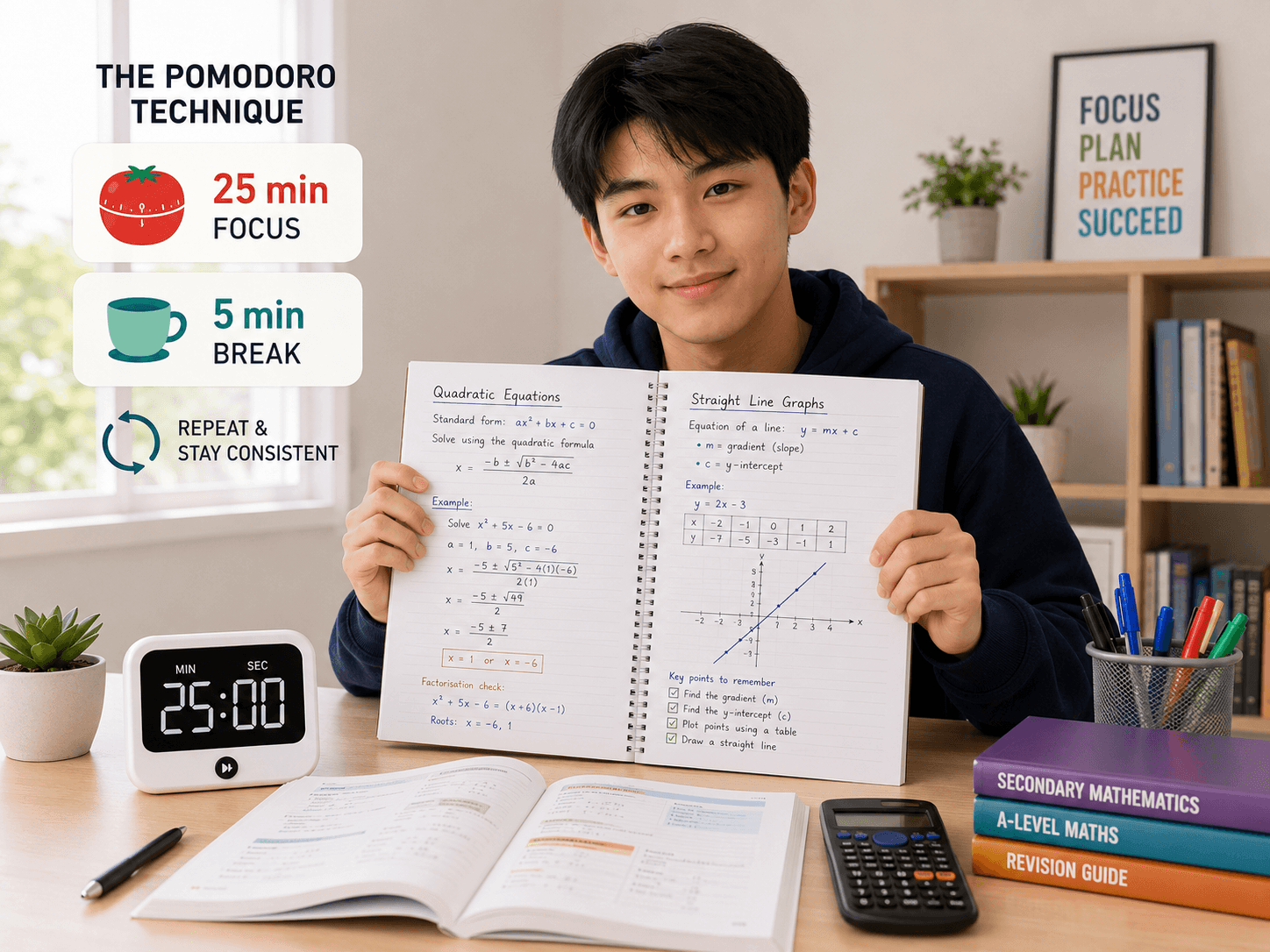
The Question / Scenario Explanation
Source: Studied for 2 hours and remember nothing?
The video explains a common study problem: a student spends hours studying, but cannot remember much afterwards. The issue may be that the student is studying without focus, breaks, or a clear system.
The suggested method is the Pomodoro technique. It was named after a tomato-shaped kitchen timer, as “pomodoro” means tomato in Italian.
The basic method is:
- Study for \(25\) minutes with zero distractions.
- Take a \(5\)-minute break when the timer rings.
- Repeat another \(25\)-minute study block.
- After \(4\) rounds, take a longer break of \(15\) to \(30\) minutes.
This works because the brain is better at focused study when it has proper recovery periods.
Step-by-Step Solution / Explanation
Step 1: Understand Why Long Study Sessions May Not Work
Studying for two hours without a plan can feel productive, but it may not lead to strong memory. Students may read notes repeatedly without really processing the information.
For Maths, this can be a problem because students need to solve questions actively. Reading worked examples is not enough. They need to practise, make mistakes, correct them, and try again.
Step 2: Set a Timer for 25 Minutes
The first step in the Pomodoro technique is to set a timer for \(25\) minutes.
During this time, students should focus on one clear task. For example:
- Complete \(5\) algebra questions.
- Review one chapter summary.
- Redo questions from a recent test.
- Practise one trigonometry method.
- Correct mistakes from homework.
The goal is to make the \(25\)-minute block specific and focused.
Step 3: Remove All Distractions
The video highlights “zero distractions”. This means no phone, no YouTube, no chatting, and no switching between tasks.
During the \(25\)-minute block, students should keep only the necessary materials on the table, such as:
- Maths worksheet
- Notebook
- Calculator, if needed
- Pen and correction materials
- Formula sheet, if allowed for revision
This helps the brain focus on the learning task instead of jumping between distractions.
Step 4: Take a 5-Minute Break
When the timer rings, stop studying and take a \(5\)-minute break.
This break should be used to reset the mind. Students can:
- walk around
- drink water
- stretch
- rest their eyes
- stare at the ceiling for a short while
The break should not become a long phone-scrolling session, because that can make it harder to return to studying.
Step 5: Repeat for Four Rounds
One \(25\)-minute study block plus one \(5\)-minute break is one Pomodoro round.
After completing \(4\) rounds, students would have done:
\(4 \times 25 = 100\) minutes of focused study
This is much more effective than sitting for two hours while distracted and unfocused.
Step 6: Take a Longer Break After Four Pomodoros
After \(4\) Pomodoros, take a longer break of about \(15\) to \(30\) minutes.
This longer break helps the brain recover before starting another study cycle. It is useful for longer revision days, especially when students are preparing for WA, EOY, or O Level exams.
Step 7: Use Pomodoro for Maths Revision Properly
For Secondary Maths, students should not use the Pomodoro technique only to read notes. It works best when paired with active revision.
Good Maths Pomodoro tasks include:
- Attempting exam-style questions
- Redoing wrong questions
- Writing down common mistakes
- Practising one method repeatedly
- Testing recall without looking at notes
This turns the method into a powerful study routine, not just a timer habit.
Key Concepts Students Must Know
- The Pomodoro technique uses study sprints: Students work for \(25\) minutes, then take a short break.
- Breaks are part of the method: They help the brain recover and stay focused for the next round.
- Zero distractions matter: A focused \(25\)-minute session is more useful than a distracted two-hour session.
- Maths revision must be active: Students should practise questions, not just read notes.
- After four rounds, take a longer break: This helps prevent mental fatigue.
Exam Tips / Common Mistakes
Exam Tips
- Choose one clear Maths task before starting each \(25\)-minute session.
- Keep your phone away during the study block.
- Use the \(5\)-minute break to rest, not to start another distracting activity.
- Track what you completed after each Pomodoro.
- Use one Pomodoro for corrections, because reviewing mistakes is important for exam improvement.
Common Mistakes
- Using the timer but still checking the phone.
- Reading notes passively instead of practising questions.
- Skipping the break and burning out faster.
- Taking a \(5\)-minute break that becomes \(30\) minutes.
- Starting a session without knowing what to study.
A common exam preparation mistake is thinking that long hours automatically mean good revision. In reality, focused practice is more important than simply sitting at the desk for a long time.
Parent Insight
Parents may see their child spending many hours at the desk, but the results may not improve if the revision is not focused. The Pomodoro technique gives students a simple structure that makes study time easier to manage.
Instead of asking only, “How long did you study?”, parents can ask:
- “What did you complete in your \(25\)-minute block?”
- “Which mistake did you correct today?”
- “Did you study without distractions?”
- “What is your next Pomodoro task?”
These questions encourage better study habits. For Maths, this is especially helpful because progress often comes from consistent practice, not last-minute cramming.
Conclusion
The Pomodoro technique is a simple but effective way to make revision more focused. Instead of studying for hours with low concentration, students can use \(25\)-minute study blocks, \(5\)-minute breaks, and longer recovery after four rounds.
For Secondary Maths students, this method works best when each session has a clear goal, such as practising questions, correcting mistakes, or reviewing one topic.
With consistent use, students can study more efficiently, remember more, and feel less overwhelmed during exam preparation.
Visit our homepage: Click Here…
Read more on our blog: Click Here…
Start here (limited slots weekly):
Free Trial: Click Here…
Enroll: Click Here…
Explore our main tuition brand approach here: Click Here… .