Introduction
The cosine rule is one of the most useful formulas in Secondary Maths, especially when a triangle does not have a right angle. Many students feel intimidated by the formula at first, but once they understand when to use it and how to substitute values properly, it becomes much more manageable.
In this example, we are given two sides of a triangle and the angle between them. We will use the cosine rule to find the third side step by step.
This is a common O Level E Maths skill, so it is worth learning a clear method that you can rely on during exams.
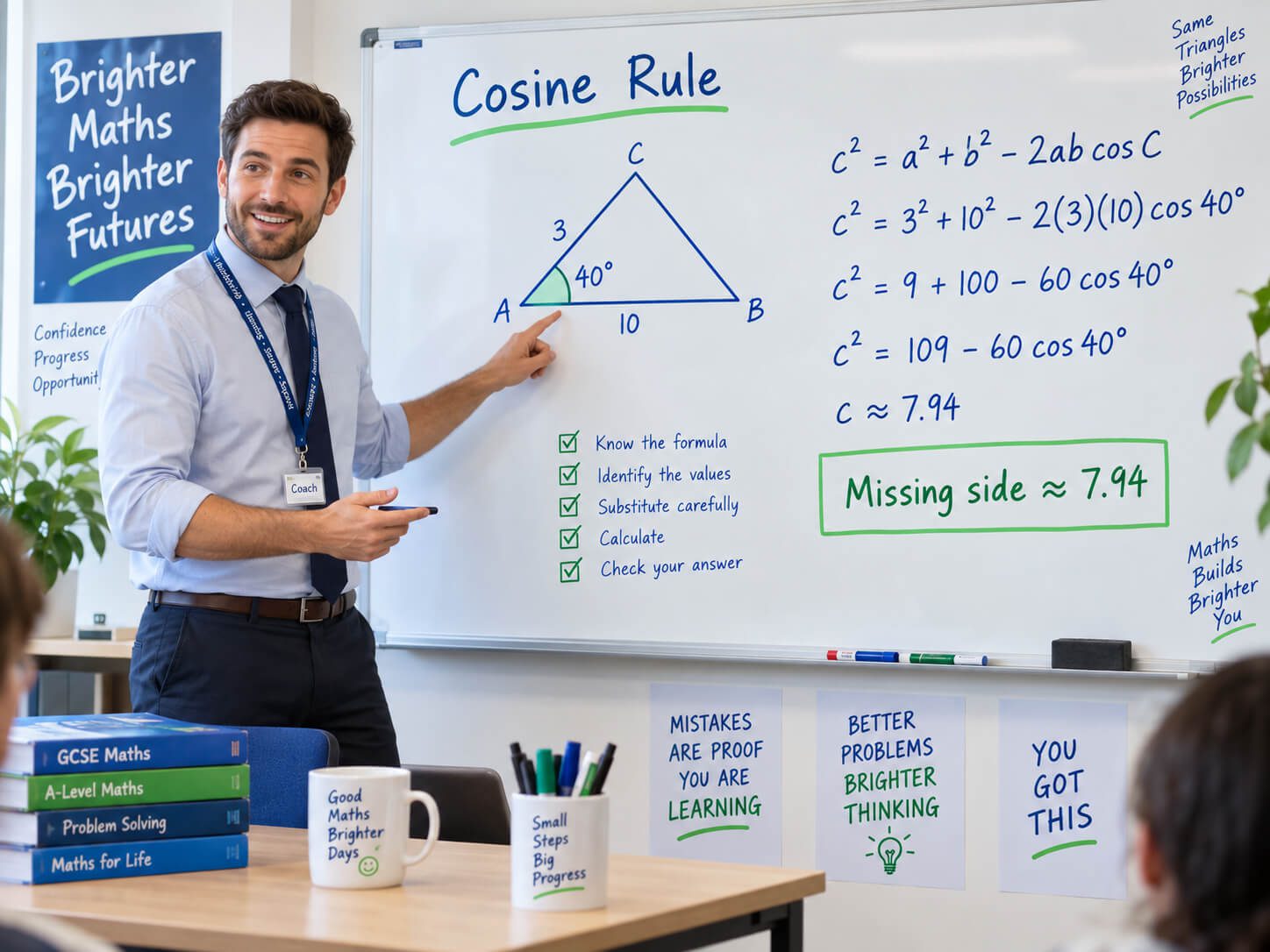
The Question / Scenario Explanation
Source: No right angle? No problem. Cosine Rule: \( a^2 = b^2 + c^2 – 2bc\cos A \)
In the triangle shown, we are given:
- one side of length \(3\)
- another side of length \(10\)
- the included angle of \(40^\circ\)
We want to find the unknown side.
To use the cosine rule correctly, we label the unknown side as \(a\), and the two known sides as \(b\) and \(c\). The angle opposite side \(a\) is labelled \(A\).
So for this question:
\( a = ? \)
\( b = 3 \)
\( c = 10 \)
\( A = 40^\circ \)
The cosine rule we will use is:
\( a^2 = b^2 + c^2 – 2bc\cos A \)
Step-by-Step Solution / Explanation
Step 1: Identify the Correct Formula
Since we know two sides and the angle between them, this is a standard cosine rule question.
The formula is:
\( a^2 = b^2 + c^2 – 2bc\cos A \)
This formula helps us find the side opposite the given angle.
Step 2: Label the Triangle Properly
To avoid confusion, remember this rule:
- lowercase letters \(a\), \(b\), \(c\) represent side lengths
- uppercase letters \(A\), \(B\), \(C\) represent angles
- side \(a\) is opposite angle \(A\)
In this question, the unknown side is opposite the \(40^\circ\) angle, so that side is labelled \(a\).
Step 3: Substitute the Values into the Formula
Now substitute:
\( b = 3 \)
\( c = 10 \)
\( A = 40^\circ \)
into the formula:
\( a^2 = 3^2 + 10^2 – 2(3)(10)\cos 40^\circ \)
Step 4: Simplify the Squares and Multiplication
Work through each part carefully:
\( 3^2 = 9 \)
\( 10^2 = 100 \)
\( 2(3)(10) = 60 \)
So:
\( a^2 = 9 + 100 – 60\cos 40^\circ \)
\( a^2 = 109 – 60\cos 40^\circ \)
Step 5: Use the Calculator Correctly
Now evaluate \( \cos 40^\circ \).
\( \cos 40^\circ \approx 0.7660 \)
So:
\( a^2 \approx 109 – 60(0.7660) \)
\( a^2 \approx 109 – 45.96 \)
\( a^2 \approx 63.04 \)
Depending on rounding, this may appear as about \(63.0\).
Step 6: Find the Side Length
We are not done yet because this is \(a^2\), not \(a\).
Take the square root of both sides:
\( a = \sqrt{63.04} \)
\( a \approx 7.94 \)
So the missing side is:
\( a \approx 7.94 \)
Step 7: State the Final Answer Clearly
The required side length is:
\( \boxed{7.94} \)
If the question asks for units, include them as well.
Step 8: Check Whether the Answer Is Reasonable
Before moving on, do a quick check.
The two given sides are \(3\) and \(10\), so the third side should be more than the difference \(10 – 3 = 7\) and less than the sum \(10 + 3 = 13\).
Our answer, \(7.94\), fits this range, so it is reasonable.
Key Concepts Students Must Know
- The cosine rule is used when you know two sides and the included angle, or when you know all three sides and want to find an angle.
- The formula is \( a^2 = b^2 + c^2 – 2bc\cos A \).
- Side \(a\) must be opposite angle \(A\).
- Lowercase letters usually represent sides, while uppercase letters represent angles.
- After finding \(a^2\), always take the square root to get \(a\).
- Make sure your calculator is in degree mode when working with angles like \(40^\circ\).
Exam Tips / Common Mistakes
Exam Tips
- Always label the triangle first before substituting into the formula.
- Check that the angle used is the one between the two known sides.
- Use brackets carefully, especially in the \(2bc\cos A\) part.
- Keep more digits in your calculator before rounding the final answer.
- Do a quick reasonableness check to make sure the side length makes sense.
Common Mistakes
- Using the wrong formula: Some students confuse the cosine rule with the sine rule.
- Matching the wrong side to the wrong angle: The formula only works properly when side \(a\) is opposite angle \(A\).
- Forgetting to square the side lengths: \(3^2\) and \(10^2\) must be calculated first.
- Stopping at \(a^2\): You must still take the square root to find \(a\).
- Calculator mode error: If your calculator is in radian mode instead of degree mode, your answer will be wrong.
- Rounding too early: This can change the final value slightly.
Parent Insight
Trigonometry often feels difficult to students because there are several formulas and they are unsure which one to choose. In reality, many problems become simpler once students recognise the structure of the question.
For cosine rule questions, parents can help by asking three simple prompts: “What do you know?”, “What do you need to find?”, and “Is the angle between the two known sides?” These questions help students decide whether the cosine rule is the right method.
Encouraging students to label the triangle clearly before calculating can also reduce careless mistakes significantly.
Conclusion
The cosine rule is a powerful method for finding a missing side in a triangle when there is no right angle.
In this example, we used:
\( a^2 = b^2 + c^2 – 2bc\cos A \)
with:
\( b = 3,\; c = 10,\; A = 40^\circ \)
This gave:
\( a^2 \approx 63.04 \)
and therefore:
\( a \approx 7.94 \)
So the missing side is \(7.94\).
Once students understand how to label the triangle and substitute correctly, cosine rule questions become much less intimidating.
Visit our homepage: Click Here…
Read more on our blog: Click Here…
Start here (limited slots weekly):
Free Trial: Click Here…
Enrol: Click Here…
Explore our main tuition brand approach here: Click Here…