Introduction
The quadratic formula may look intimidating when students first encounter it, but it becomes much easier once you know how to identify \(a\), \(b\) and \(c\) correctly.
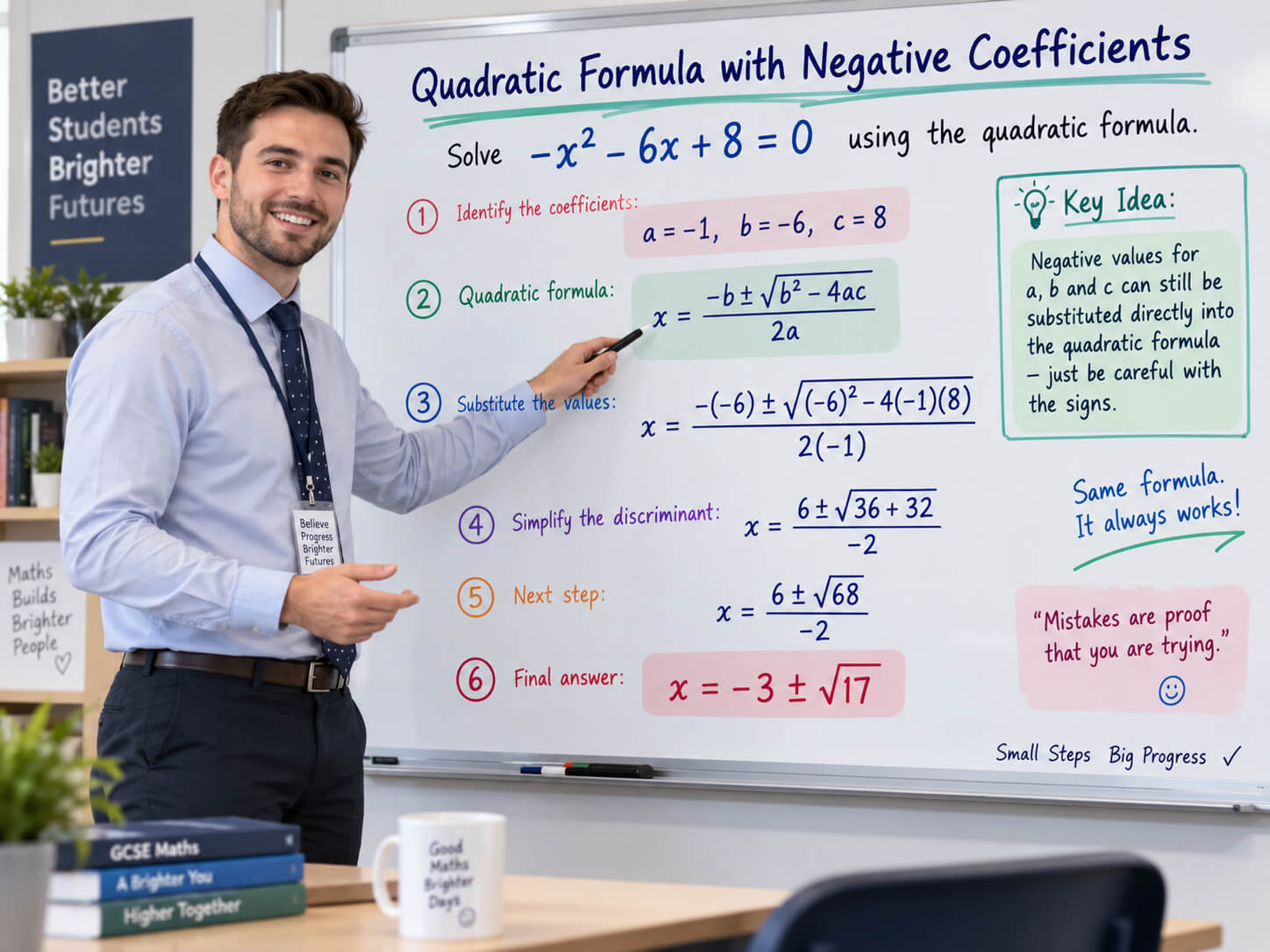
In this example, we solve \( -x^2 – 6x + 8 = 0 \). The negative coefficients make careful substitution especially important because a missed negative sign can change the entire answer.
This step-by-step approach is useful for Secondary and O Level E Maths students who want a reliable method for solving quadratic equations, especially when factorisation is not straightforward.
The Question / Scenario Explanation
Source: Solving \( -x^2 – 6x + 8 = 0 \) using the quadratic formula.
The equation is:
\( -x^2 – 6x + 8 = 0 \)
It is already written in the standard quadratic form:
\( ax^2 + bx + c = 0 \)
Therefore:
\( a = -1 \)
\( b = -6 \)
\( c = 8 \)
The signs are part of the coefficients. This means \(b\) is negative 6, not positive 6.
The formula we will use is:
Step-by-Step Solution / Explanation
Step 1: Identify a, b and c
Compare:
\( -x^2 – 6x + 8 = 0 \)
with:
\( ax^2 + bx + c = 0 \)
We get:
\( a = -1,\quad b = -6,\quad c = 8 \)
Always include the signs when identifying the coefficients.
Step 2: Substitute the Values Carefully
Substitute \(a=-1\), \(b=-6\) and \(c=8\) into the quadratic formula:
\( x = \frac{-(-6) \pm \sqrt{(-6)^2 – 4(-1)(8)}}{2(-1)} \)
Using brackets around negative values is very important because it helps prevent sign errors.
Step 3: Simplify −b
Since:
\( b = -6 \)
then:
\( -b = -(-6) = 6 \)
So the numerator begins with positive \(6\).
Step 4: Calculate the Discriminant
The expression inside the square root is called the discriminant:
\( b^2 – 4ac \)
Substitute the values:
\( (-6)^2 – 4(-1)(8) \)
Calculate each part:
\( (-6)^2 = 36 \)
and:
\( 4(-1)(8) = -32 \)
Therefore:
\( 36 – (-32) = 36 + 32 \)
\( = 68 \)
So the square-root part becomes:
\( \sqrt{68} \)
Step 5: Simplify the Denominator
The denominator is:
\( 2a \)
Since \(a=-1\):
\( 2(-1) = -2 \)
Therefore:
\( x = \frac{6 \pm \sqrt{68}}{-2} \)
Step 6: Simplify the Surd
We can simplify:
\( \sqrt{68} \)
because:
\( 68 = 4 \times 17 \)
So:
\( \sqrt{68} = \sqrt{4 \times 17} \)
\( = 2\sqrt{17} \)
This gives:
\( x = \frac{6 \pm 2\sqrt{17}}{-2} \)
Step 7: Simplify Both Solutions
Divide every term by \(-2\):
\( x = -3 \mp \sqrt{17} \)
The two roots can more conventionally be written as:
\( x = -3 + \sqrt{17} \)
or:
\( x = -3 – \sqrt{17} \)
Final Answer:
\( \boxed{x = -3 \pm \sqrt{17}} \)
Step 8: Check the Answers Approximately
Since:
\( \sqrt{17} \approx 4.123 \)
the two roots are approximately:
\( x \approx -3 + 4.123 = 1.123 \)
and:
\( x \approx -3 – 4.123 = -7.123 \)
These decimal values can be substituted back into the original equation as a reasonableness check.
Key Concepts Students Must Know
- Standard form: A quadratic equation should be written as \( ax^2 + bx + c = 0 \).
- Coefficients include their signs: In this example, \(a=-1\), \(b=-6\) and \(c=8\).
- Use brackets for negatives: Write \((-6)^2\), not \(-6^2\), when substituting \(b=-6\).
- The ± symbol gives two solutions: One solution uses addition and the other uses subtraction.
- The discriminant is \(b^2-4ac\): It provides useful information about the roots of a quadratic.
- Surds should be simplified where possible: \(\sqrt{68}=2\sqrt{17}\).
- Exact and decimal answers are different forms: \( -3 \pm \sqrt{17} \) gives the exact roots.
Exam Tips / Common Mistakes
Exam Tips
- Write down \(a\), \(b\) and \(c\) before substituting anything.
- Include the negative signs when identifying coefficients.
- Put negative numbers inside brackets when squaring them.
- Calculate the discriminant separately if the expression feels crowded.
- Remember that \(\pm\) means there are normally two values of \(x\).
- Simplify surds when an exact answer is required.
- Use your calculator only after writing the correct substitution clearly.
Common Mistakes
- Writing \(a=1\): The coefficient of \(x^2\) is actually \(-1\).
- Writing \(b=6\): The coefficient of \(x\) is \(-6\).
- Calculating \(-b\) incorrectly: Since \(b=-6\), \(-b=6\).
- Mishandling the discriminant: \( -4(-1)(8) \) ultimately contributes \(+32\), not \(-32\).
- Forgetting the negative denominator: \(2a=2(-1)=-2\).
- Giving only one root: The quadratic formula usually produces two possible solutions through the \(\pm\) symbol.
- Stopping at \(\sqrt{68}\): In exact form, it can be simplified to \(2\sqrt{17}\).
Parent Insight
The quadratic formula often looks difficult because students are trying to manage several operations and negative signs at the same time. The formula itself is usually not the biggest challenge. Careful substitution is.
A useful habit is to ask your child to identify \(a\), \(b\) and \(c\) first and write them on a separate line. This slows the process down slightly at the beginning but can prevent much larger mistakes later.
Students should also practise using brackets whenever negative numbers are substituted. This builds a reliable routine that becomes especially helpful under examination pressure.
Conclusion
To solve \( -x^2 – 6x + 8 = 0 \) using the quadratic formula, first identify:
\( a=-1,\quad b=-6,\quad c=8 \)
Substituting these values gives:
\( x = \frac{6 \pm \sqrt{68}}{-2} \)
Since:
\( \sqrt{68}=2\sqrt{17} \)
the roots simplify to:
\( \boxed{x=-3\pm\sqrt{17}} \)
The biggest lesson from this example is to handle negative coefficients carefully. Correct brackets and clear step-by-step working can prevent most quadratic formula errors.
Visit our Secondary and O Level E Maths homepage: Explore SECMathsTuition
Read more Secondary Maths guides: Visit Our Maths Blog
Start here (limited slots weekly):
Free Trial: Click Here…
Enrol: Click Here…
Explore our main tuition brand approach here: Click Here…