Introduction
The quadratic graph shape can be predicted before you even start plotting points. This is one of the quickest and most useful graph-checking habits for Secondary Maths students.
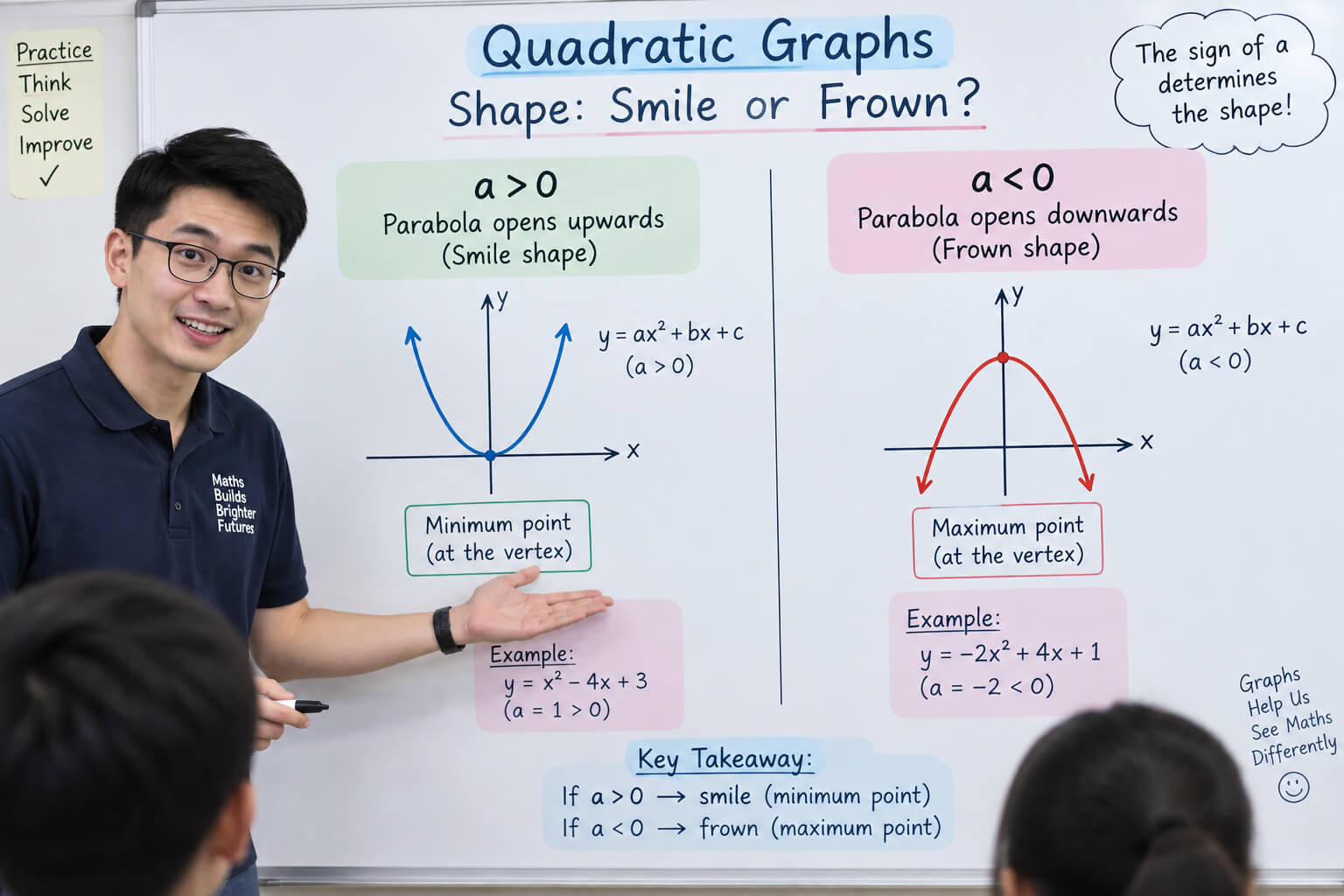
Whenever you see a quadratic equation, the first thing to check is the sign of the \(x^2\) term. A positive \(x^2\) coefficient means the graph opens upward like a smile. A negative \(x^2\) coefficient means the graph opens downward like a frown.
This simple idea can save time in graph sketching questions and help students avoid careless mistakes in O Level E Maths.
The Question / Scenario Explanation
Source: Every quadratic graph smiles or frowns. Know which before plotting!
The video introduces two very simple examples:
\( y = x^2 \)
and
\( y = -x^2 \)
Although both are quadratic graphs, their shapes are different.
For \( y = x^2 \), the coefficient of \(x^2\) is positive. The graph opens upward.
For \( y = -x^2 \), the coefficient of \(x^2\) is negative. The graph opens downward.
This is why many students remember the rule as:
- positive = smile
- negative = frown
Step-by-Step Solution / Explanation
Step 1: Recall the General Form of a Quadratic
A quadratic equation is usually written in the form:
\( y = ax^2 + bx + c \)
Here, \(a\), \(b\), and \(c\) are constants, and \(a \neq 0\).
The most important part for determining the overall graph shape is the coefficient \(a\), which is the number in front of \(x^2\).
Step 2: Check the Sign of the \(x^2\) Coefficient
If \(a > 0\), the graph opens upward.
If \(a < 0\), the graph opens downward.
So the sign of \(a\) tells you immediately whether the parabola smiles or frowns.
This is the key idea behind the quadratic graph shape.
Step 3: Look at a Positive Example
Consider:
\( y = x^2 \)
Here, the coefficient of \(x^2\) is:
\( a = 1 \)
Since \(1\) is positive, the graph opens upward.
This means the parabola has a smiling shape.
Another example:
\( y = 3x^2 – 5 \)
Here, the coefficient of \(x^2\) is:
\( a = 3 \)
Since \(3\) is positive, this graph also opens upward.
So for the quick test in the video, \( y = 3x^2 – 5 \) is a happy or smiling graph.
Step 4: Look at a Negative Example
Now consider:
\( y = -x^2 \)
Here, the coefficient of \(x^2\) is:
\( a = -1 \)
Since \(-1\) is negative, the graph opens downward.
This gives a frowning shape.
Another example:
\( y = -2x^2 + 4x + 1 \)
Here:
\( a = -2 \)
Since \(-2\) is negative, the graph opens downward.
Step 5: Understand What Does Not Change the Direction
Students sometimes think the values of \(b\) and \(c\) affect whether the graph opens upward or downward. They do not.
In:
\( y = ax^2 + bx + c \)
The values of \(b\) and \(c\) can shift the graph and change the turning point, but the direction of opening still depends only on \(a\).
For example:
\( y = x^2 + 10x + 7 \)
Since \(a = 1\), the graph opens upward.
And:
\( y = -x^2 + 8x – 3 \)
Since \(a = -1\), the graph opens downward.
Step 6: Connect This to the Turning Point
If the graph opens upward, the turning point is a minimum point.
If the graph opens downward, the turning point is a maximum point.
So the sign of \(a\) also helps you understand the nature of the turning point before doing any detailed work.
Step 7: Use This as a Quick Exam Check
Before sketching any quadratic graph, ask yourself:
Is the coefficient of \(x^2\) positive or negative?
This takes only a second, but it helps you avoid drawing the graph in the wrong direction.
For example:
- \( y = 4x^2 + 3x – 1 \) → opens upward
- \( y = -5x^2 + 2x + 6 \) → opens downward
Key Concepts Students Must Know
- A quadratic graph has the general form \( y = ax^2 + bx + c \).
- The coefficient \(a\) determines the direction of opening.
- If \(a\) is positive, the graph opens upward.
- If \(a\) is negative, the graph opens downward.
- The values of \(b\) and \(c\) affect position and shape details, but not whether the graph smiles or frowns.
- An upward-opening graph has a minimum point.
- A downward-opening graph has a maximum point.
Exam Tips / Common Mistakes
Exam Tips
- Always check the sign of the \(x^2\) term before plotting points.
- Write the equation in the standard form \( y = ax^2 + bx + c \) if needed.
- Use “positive = smile, negative = frown” as a quick memory trick.
- Link the direction of opening to the turning point: minimum for upward, maximum for downward.
- Use this rule to check whether your sketch is reasonable before moving on.
Common Mistakes
- Looking at the constant term instead of the \(x^2\) term: The value of \(c\) does not decide the opening direction.
- Letting the \(x\) term confuse you: The value of \(b\) can move the graph sideways, but it does not change the smile or frown.
- Forgetting that a negative coefficient flips the graph: \( y = -x^2 \) must open downward.
- Drawing the correct turning point but in the wrong direction: Always check the sign of \(a\) first.
- Assuming a bigger coefficient changes the direction: A larger positive number like \(5x^2\) still opens upward. A larger negative number like \(-5x^2\) still opens downward.
Parent Insight
Graph sketching often becomes easier when students have a few reliable checking habits. Instead of memorising many disconnected facts, students should learn to identify the most important feature first.
For quadratic graphs, that feature is the sign of the \(x^2\) coefficient. Once a student understands this, they can quickly tell whether the graph opens upward or downward even before finding the turning point or plotting a table of values.
This builds confidence and helps students approach graph questions more logically rather than by guesswork.
Conclusion
The quickest way to determine the quadratic graph shape is to check the sign of the coefficient of \(x^2\).
In the general form:
\( y = ax^2 + bx + c \)
If \(a\) is positive, the graph opens upward.
If \(a\) is negative, the graph opens downward.
So:
\( y = x^2 \) smiles.
\( y = -x^2 \) frowns.
And:
\( y = 3x^2 – 5 \)
also smiles because the coefficient of \(x^2\) is positive.
Visit our homepage: Click Here…
Read more on our blog: Click Here…
Start here (limited slots weekly):
Free Trial: Click Here…
Enrol: Click Here…
Explore our main tuition brand approach here: Click Here…